
Introduction
If someone tried paying you today with a massive copper object shaped like an X, your first reaction would probably be confusion.
Most modern people do not associate copper with wealth anymore. Gold feels valuable. Silver still carries prestige. Diamonds trigger ideas of rarity and luxury. Copper, on the other hand, feels industrial. It belongs in electrical wiring, plumbing, factories, and commodity markets.
That is what makes the story of the Katanga Crosses so fascinating.
For centuries, enormous copper crosses circulated as currency across parts of Central Africa, especially in the region now known as the Democratic Republic of the Congo. These objects were not small coins carried inside pockets. Some weighed several pounds and looked more like ceremonial weapons or religious artifacts than money.
Yet entire economic systems treated them as valuable stores of wealth.
At first, that sounds irrational through a modern lens. But then you remember something important about human psychology: rarity changes everything.
Humans consistently attach value to objects that are difficult to obtain, difficult to produce, and visibly scarce. The material itself matters, but scarcity matters even more. Gold became valuable partly because it was rare. Diamonds built entire industries around controlled scarcity. Even modern collectibles often gain value simply because few exist.
The Katanga Crosses reveal what happens when a society turns an industrial metal into a symbol of wealth, status, and economic power long before modern banking systems existed.
What Were the Katanga Crosses?
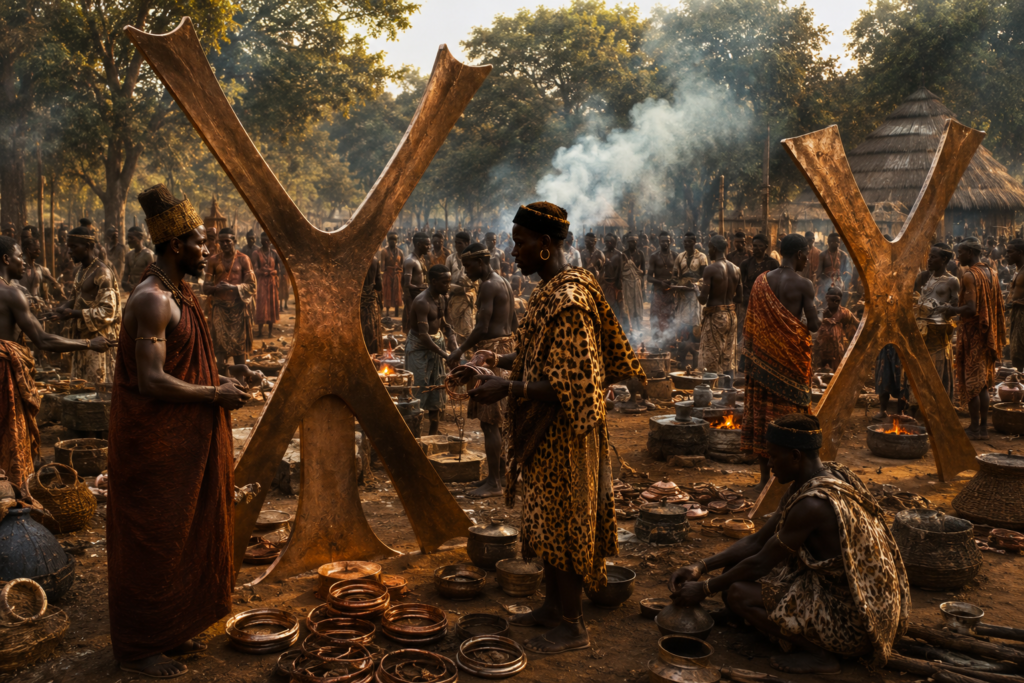
The Katanga Crosses were large X-shaped copper ingots used as currency in Central Africa, particularly in the Katanga region of present-day Democratic Republic of the Congo.
Most crosses were cast from copper mined locally in one of the richest mineral regions in Africa. The objects varied in size and weight, but many measured roughly eight inches across and weighed around two pounds or more.
The shape itself was distinctive.
Unlike ordinary bars or coins, the ingots formed broad symmetrical X-patterns with flared ends. Historians still debate whether the design evolved primarily for practical, symbolic, or cultural reasons. Whatever the original explanation, the shape became widely recognizable across trading networks.
The crosses served multiple economic purposes simultaneously.
They functioned as:
- Currency for trade
- Stores of wealth
- Dowry payments in marriages
- Status symbols
- Long-distance trade goods
- Indicators of political influence
That combination made them far more important than simple metal objects.
The crosses also existed within broader regional trade systems connecting Central Africa with neighboring kingdoms and commercial networks. Copper itself was highly valued because producing large quantities required mining knowledge, labor organization, and access to mineral deposits.
Scarcity gave the material economic power.
And unlike paper money, the value felt physically real.
The Katanga Region and Copper Wealth
The Katanga region became famous for mineral wealth long before European colonial powers arrived in Central Africa.
Located in the southern part of modern Congo, Katanga contains enormous copper deposits alongside cobalt and other minerals. Archaeological evidence suggests local societies mined and worked copper for centuries before large-scale colonial extraction began.
Copper production in the region likely expanded significantly between the fourteenth and nineteenth centuries. Local metallurgists developed sophisticated techniques for smelting and casting copper objects, including tools, jewelry, weapons, and eventually the famous crosses.
The Kingdom of Luba and the Kingdom of Lunda both participated in regional trade systems connected to copper production. These states grew partly through control over trade routes, labor systems, and mineral wealth.
Copper became economically powerful because it was not easily accessible everywhere.
This is something modern industrial societies sometimes forget.
Today copper feels common because global mining operations produce massive quantities for industrial use. But in pre-industrial societies, extracting and processing metal required tremendous effort. Large visible copper objects represented concentrated labor, specialized knowledge, and geographic advantage.
That made the Katanga Crosses psychologically convincing as wealth.
Human beings consistently associate difficult production with value. Rare objects feel important because scarcity suggests effort, limitation, and exclusivity. That instinct appears repeatedly across history.
Gold.
Silver.
Gems.
Rare art.
Limited collectibles.
The underlying psychology remains surprisingly consistent.
How the Katanga Crosses Actually Worked
The Katanga Crosses circulated through local and regional economies as recognized units of value.
Unlike modern national currencies with fixed exchange rates, value often depended on local conditions, copper supply, political influence, and trading relationships. Even so, the crosses became standardized enough that communities broadly understood their purchasing power.
Historical accounts suggest a single cross could purchase significant goods depending on the period and region.
Examples included:
- Livestock
- Food supplies
- Tools
- Trade goods
- Marriage dowries
- Labor agreements
The crosses also played important ceremonial and social roles.
In many African societies during this period, wealth was not purely individual. Economic value often connected directly to family alliances, social obligations, and political relationships.
That meant the crosses carried symbolic meaning beyond raw material value.
| Characteristic | Katanga Crosses |
|---|---|
| Region | Katanga, Central Africa |
| Material | Copper |
| Shape | Large X-shaped ingots |
| Time Period | Mainly 14th–19th centuries |
| Main Uses | Currency, dowries, trade, status |
| Production Method | Smelting and casting |
| Economic Role | Regional trade currency |
| Source of Value | Copper scarcity and labor intensity |
The physical appearance of the crosses mattered too.
Large heavy objects naturally create impressions of importance. Humans often associate physical weight with seriousness and value. Even modern luxury products frequently emphasize heft, density, and material presence because people subconsciously interpret those qualities as signals of worth.
The Katanga Crosses benefited from that same instinct.
Why Copper Became Valuable Enough to Function as Money
One reason the Katanga Crosses feel strange to modern readers is because copper no longer occupies the same psychological category as precious metals.
Today, copper trades globally as an industrial commodity.
But historical value is highly contextual.
In pre-industrial Central Africa, copper represented something very different. Mining required organized labor, technical expertise, fuel for smelting, transportation networks, and access to specific geographic regions.
That combination created scarcity.
And scarcity is one of the oldest foundations of money.
Many early currencies emerged not because the materials were inherently magical, but because societies collectively recognized them as difficult to acquire.
Several factors strengthened copper’s role in regional economies:
- Mineral deposits were geographically concentrated
- Smelting required specialized knowledge
- Large copper objects stored wealth visibly
- Copper resisted decay better than many goods
- Trade networks already valued metal products
- Production required substantial labor investment
This also explains why modern people psychologically separate metals differently.
Gold still feels valuable partly because scarcity remains culturally reinforced. Copper lost some of that prestige because industrial production transformed it into a mass commodity.
The material itself changed very little.
Human perception changed enormously.
Katanga Crosses vs. Modern Money
The Katanga Crosses reveal how much money depends on collective belief systems.
Modern people often assume contemporary currencies are fundamentally more rational than historical forms of money. But the deeper you look, the more similarities begin appearing.
The crosses held value because societies agreed they represented wealth, labor, scarcity, and exchange potential.
Modern currencies function similarly.
| Katanga Crosses | Modern Money |
|---|---|
| Value tied partly to scarcity | Value tied to trust and monetary policy |
| Physically heavy and visible | Mostly digital and invisible |
| Required labor-intensive production | Created through financial systems |
| Used for trade and status | Used for trade and status too |
| Accepted through social agreement | Accepted through institutional trust |
| Regional circulation networks | Global banking networks |
One major difference involves physicality.
The Katanga Crosses felt undeniably tangible. People could see the material, hold the weight, and recognize the labor involved in producing them.
Modern money often feels abstract by comparison.
Most global wealth today exists digitally as numbers stored across banking systems and financial databases. The psychological connection between money and physical material has weakened dramatically.
That shift changed how people emotionally experience wealth itself.
Colonialism and the End of the Crosses
European colonial expansion eventually transformed the economic systems surrounding the Katanga Crosses.
During the late nineteenth century, King Leopold II of Belgium established control over the Congo Free State, one of the most brutal colonial regimes in modern history. European powers became intensely interested in Central Africa partly because of its enormous mineral wealth.
Industrial extraction changed everything.
Colonial mining operations dramatically expanded copper production using forced labor systems and industrial infrastructure. European colonial authorities also introduced centralized monetary systems tied to imperial administration.
The older regional economies built around copper crosses gradually lost importance.
Industrialization altered scarcity itself.
Once copper became extractable on much larger scales for global industrial markets, the old psychological and economic foundations supporting the crosses weakened. Modern state currencies backed by colonial power eventually replaced many traditional regional exchange systems.
Even so, the Katanga Crosses never fully disappeared from history.
Collectors, historians, and museums preserved many surviving examples. Today the crosses remain important cultural and historical artifacts representing Central Africa’s pre-colonial trade systems and metallurgical sophistication.
What the Katanga Crosses Reveal About Human Nature
The story of the Katanga Crosses exposes how deeply human beings connect value with rarity.
People often assume modern economies operate purely through rational logic, but emotional perception plays a massive role in how societies assign worth.
Objects that appear difficult to obtain naturally attract status and prestige.
That pattern repeats constantly throughout history.
Rare metals became money.
Rare gems became luxury symbols.
Rare art became investment assets.
Rare digital collectibles now sell for enormous amounts online.
The object itself matters less than the collective agreement surrounding scarcity.
The Katanga Crosses also reveal how quickly perceptions of value can change over time.
A metal once treated as concentrated wealth now feels ordinary to many modern people because industrialization transformed supply conditions. Human psychology responds strongly to perceived scarcity, but scarcity itself is never permanent.
That insight matters today more than ever.
Modern financial systems still rely heavily on narratives about rarity, exclusivity, and limited access. Sometimes those narratives involve precious metals. Other times they involve luxury brands, collectibles, technology, or digital assets.
The mechanics evolve.
The psychology remains remarkably stable.
Conclusion
The Katanga Crosses sound strange at first because modern people no longer associate copper with wealth.
But in pre-industrial Central Africa, these giant X-shaped ingots represented something powerful: visible scarcity transformed into economic trust.
The crosses stored labor, mining expertise, regional influence, and social status inside a single object. Entire trade systems accepted them because communities collectively recognized the difficulty of producing and obtaining them.
That logic never fully disappeared.
Modern economies still revolve around scarcity, perception, and shared belief. Humans continue assigning enormous value to objects considered rare, difficult to access, or symbolically important.
The Katanga Crosses simply reveal an older version of the same instinct.
Long before digital banking, stock markets, and cryptocurrencies, societies already understood one of the central truths behind money: rarity is often powerful enough to become belief, and belief is powerful enough to become wealth.
The Katanga Crosses of Central Africa reveal how giant copper ingots became money through scarcity, labor, and collective belief.