
Introduction
Most cities punish people for trying to live outside the system.
Rent rises endlessly, property values dominate entire neighborhoods, and nearly every urban space eventually becomes optimized for consumption. Coffee shops turn into chains, artists get priced out, and communities slowly transform into investment assets.
That is part of what made Christiania so strange.
In the middle of Copenhagen, one of Europe’s wealthiest and most organized capitals, a self-declared autonomous neighborhood emerged in 1971 and attempted to create its own economic and social rules. Residents occupied abandoned military barracks, rejected traditional property ownership, built communal systems, and tried constructing a society that operated differently from mainstream capitalism.
At first glance, the idea sounds either liberating or completely chaotic depending on your personality.
But what makes Christiania fascinating is that parts of it actually worked for decades.
People shared spaces, organized collectively, built businesses, created art, and developed local economic structures that often felt radically different from ordinary urban life. In some ways, the neighborhood resembled an enormous social experiment asking a difficult question:
How much of modern economic life is truly necessary, and how much simply became normal because everyone accepts it?
The deeper you study Christiania, the harder it becomes to categorize neatly.
It was idealistic, dysfunctional, creative, contradictory, and surprisingly resilient all at once.
The Birth of Christiania
Christiania officially began in September 1971 when residents and activists occupied abandoned military land in Copenhagen’s Christianshavn district.
The area had previously belonged to the Danish military and contained old barracks, warehouses, and defensive structures. During the late 1960s and early 1970s, Denmark experienced many of the same social tensions affecting Western societies more broadly: housing shortages, youth counterculture movements, anti-authoritarian politics, and growing criticism of consumer-driven lifestyles.
Families searching for affordable housing initially entered the abandoned military zone partly out of practical necessity.
Artists, hippies, activists, and alternative thinkers soon followed.
The occupation gradually evolved into something much larger than temporary squatting. Residents declared the area “Freetown Christiania” and began building a semi-autonomous community with its own rules, social norms, and economic practices.
The timing mattered.
The early 1970s represented a period when many young people across Europe and North America questioned whether industrial capitalist societies were actually producing happier lives. Traditional institutions still appeared stable on the surface, but countercultural movements increasingly challenged ideas surrounding property, authority, work, and consumption.
Christiania became one of the most visible attempts to transform those criticisms into a functioning community.
Rejecting Traditional Property Rules
One of Christiania’s most radical ideas involved property itself.
Residents generally rejected conventional private ownership structures inside the neighborhood. Instead of individuals fully owning land and buildings through normal market systems, many spaces operated collectively or through community agreements.
That immediately created tension with mainstream legal and economic frameworks.
Modern cities depend heavily on property values. Real estate taxation, investment markets, mortgages, rents, and urban development all revolve around clearly defined ownership rights.
Christiania attempted something different.
The community emphasized use over speculation.
In practice, this meant residents often viewed homes less as investment assets and more as living spaces embedded within a collective social project. People built houses, modified structures, and shared communal responsibilities without fully participating in traditional property markets.
That idea sounds liberating to many people because modern urban life increasingly feels financially suffocating.
Large gated condominiums sometimes create surprisingly similar feelings on a smaller scale. Shared amenities, semi-collective environments, and insulated internal communities can make residents feel temporarily removed from the surrounding city. Christiania represented a far more radical version of that instinct.
The neighborhood effectively asked whether communities could exist without reducing every square meter into speculative financial value.
How the Christiania Economy Worked
Christiania never fully escaped Denmark’s broader economy.
Residents still used Danish currency, interacted with outside businesses, paid for supplies, and depended partly on the surrounding state infrastructure. That reality became one of the central contradictions defining the experiment.
Even communities trying to operate differently still remain connected to larger economic systems.
Inside Christiania, however, economic life often functioned through alternative priorities.
The neighborhood developed:
- Communal decision-making systems
- Cooperative businesses
- Shared maintenance responsibilities
- Artistic and craft-based local economies
- Informal labor arrangements
- Community-focused resource management
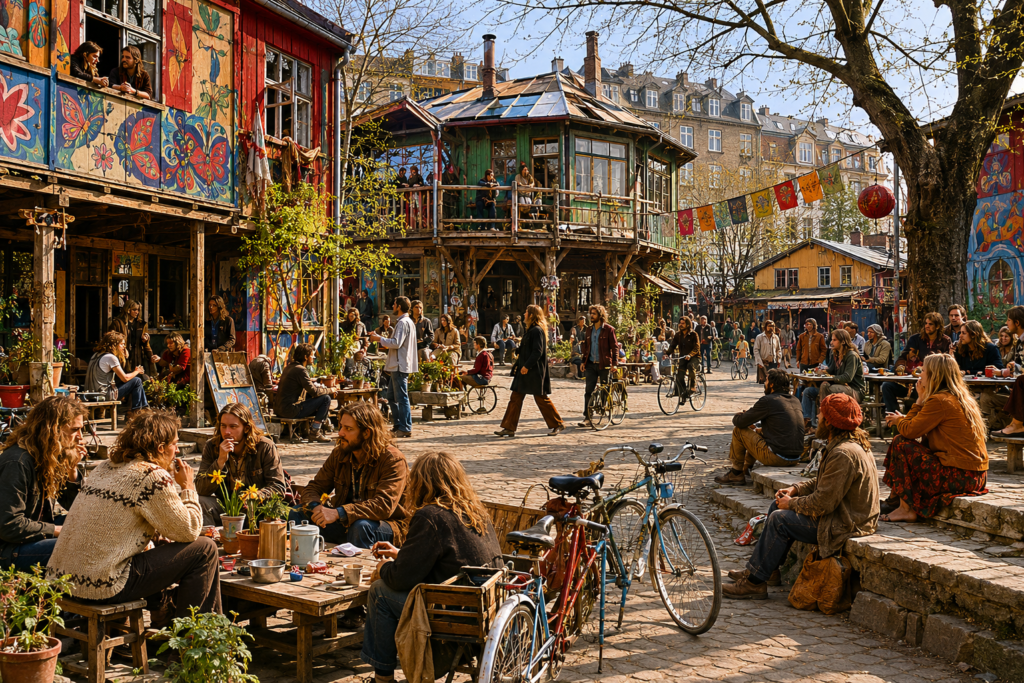
Christiania also became famous for local markets, handmade goods, music venues, cafes, bicycle workshops, and artistic spaces.
The area attracted tourism while simultaneously criticizing mainstream commercial culture.
That contradiction created constant tension.
The community needed money to survive but also wanted to resist becoming fully absorbed into ordinary market logic.
| Characteristic | Christiania’s Economic Model |
|---|---|
| Founded | 1971 |
| Location | Copenhagen, Denmark |
| Original Space | Abandoned military barracks |
| Property Philosophy | Collective and community-oriented |
| Main Economic Activity | Small businesses, arts, tourism, local trade |
| Governance Style | Collective decision-making |
| Relationship With State | Semi-autonomous but legally contested |
| Main Tension | Balancing alternative ideals with economic reality |
That final point became especially important over time.
Completely separating from national economic systems proved almost impossible.
Why Christiania Became Internationally Famous
Christiania attracted global attention partly because it survived much longer than most people expected.
Many outsiders assumed the project would collapse quickly into disorder, poverty, or internal conflict. Instead, the neighborhood endured for decades while developing its own recognizable culture and identity.
Tourists, journalists, academics, and political activists from around the world visited Christiania to observe how the experiment functioned.
The neighborhood became associated with:
- Anti-consumer culture
- Alternative living arrangements
- Artistic freedom
- Communal economics
- Political activism
- Urban autonomy
At the same time, Christiania’s reputation often became romanticized.
The reality inside the neighborhood was much messier.
Conflicts emerged constantly over governance, crime, drug markets, tourism pressure, maintenance costs, and negotiations with the Danish government.
This is where many alternative communities struggle.
The idealism itself is rarely the only problem.
The deeper issue is that no community exists entirely outside surrounding political and economic systems. Christiania still depended on Denmark’s broader stability, infrastructure, legal frameworks, and national economy.
That dependence created an uncomfortable truth.
Alternative systems can partially resist mainstream structures, but completely escaping them is much harder.
The Cannabis Economy and State Conflict
One reason Christiania remained controversial involved cannabis sales.
For decades, an area known as Pusher Street became famous for open cannabis trade operating semi-publicly inside the neighborhood. While harder drugs were officially rejected by many Christiania residents, cannabis commerce became deeply associated with the area’s economy and public image.
This created ongoing conflict with Danish authorities.
Police raids, legal disputes, and political pressure became recurring features of Christiania’s history. Critics argued the neighborhood enabled criminal activity and undermined state authority. Supporters countered that aggressive policing often worsened problems rather than solving them.
The cannabis economy also exposed another contradiction.
Alternative communities still need economic engines.
In wealthy urban environments, unconventional neighborhoods sometimes survive precisely because surrounding cities generate enough tourism, cultural attention, and disposable income to sustain them.
That dynamic matters.
A “mini-Christiania” emerging inside a wealthy area could potentially attract artists, tourism, cafes, cultural businesses, and alternative markets while still benefiting indirectly from nearby economic strength.
In poorer regions, however, similar experiments often risk becoming associated less with autonomy and more with economic abandonment.
That difference shapes how societies interpret alternative communities.
Christiania vs. Traditional Urban Economics
Christiania became fascinating partly because it challenged assumptions modern cities usually treat as permanent.
Most urban economies prioritize growth, property appreciation, investment, and commercial efficiency. Christiania emphasized community identity, shared space, and alternative social structures.
| Traditional Urban Model | Christiania Model |
|---|---|
| Property as investment asset | Property as communal living space |
| Hierarchical governance | Collective decision-making |
| Consumer-driven development | Community-oriented development |
| Market rents and ownership | Alternative housing structures |
| Commercial standardization | Artistic and cultural individuality |
| Economic efficiency prioritized | Social experimentation prioritized |
The comparison reveals why Christiania triggered such strong reactions.
To some people, the neighborhood represented freedom from suffocating market pressures. To others, it looked economically unrealistic and legally unstable.
Both interpretations contained truth.
Christiania succeeded partly because it existed inside one of the richest and most functional countries in the world. Denmark’s broader economic strength created conditions allowing experimentation that might collapse elsewhere.
That reality often gets overlooked.
Alternative systems rarely operate in total isolation. They usually depend partly on the stability of surrounding institutions even while criticizing them.
The Gradual Normalization of Christiania
Over time, Christiania slowly became less revolutionary and more institutionalized.
Negotiations with the Danish government eventually produced legal agreements allowing residents greater stability while also integrating parts of the neighborhood more formally into state frameworks.
The area transformed from pure occupation into something more hybrid.
Tourism increased dramatically.
Property discussions became more formalized.
Some original countercultural ideals softened under economic and political pressure.
This transformation happens frequently with alternative communities.
Once places become culturally famous, they attract attention, money, regulation, and commercialization. The very systems they originally resisted slowly begin absorbing them.
In some ways, Christiania’s survival depended on compromise.
Completely rejecting the outside system proved unrealistic. Partial coexistence became more sustainable.
That evolution disappointed some idealists but also explains why the neighborhood survived for so long.
What Christiania Reveals About Human Nature
The story of Christiania exposes something many people quietly feel about modern economic life.
A significant number of humans crave community more than optimization.
Modern cities often maximize efficiency, productivity, and property value while weakening social connection and shared identity. Christiania attempted to reverse those priorities.
That does not mean the experiment solved every problem.
Internal conflict still existed.
Crime still existed.
Economic pressure still existed.
But the neighborhood demonstrated that many people are willing to tolerate uncertainty and imperfection if they feel greater ownership over their social environment.
Christiania also revealed how difficult it is to fully escape larger systems.
Communities can challenge economic norms, redesign social rules, and create alternative structures, but total independence remains extremely rare. National economies, governments, infrastructure, and global markets continue exerting influence whether communities like it or not.
That tension probably explains why Christiania remains so compelling.
It represented both rebellion and compromise simultaneously.
A functioning reminder that humans constantly search for ways to live differently while still depending on the systems they are trying to escape.
Conclusion
Christiania began as an occupation of abandoned military land and evolved into one of the world’s most famous alternative communities.
For decades, the neighborhood experimented with collective living, alternative economics, shared space, and resistance to traditional property systems inside the middle of wealthy Copenhagen.
Some people viewed it as proof that communities could organize around cooperation rather than pure market logic.
Others saw it as chaotic idealism surviving only because Denmark’s broader stability protected it from collapse.
Both interpretations contain part of the truth.
Christiania never fully escaped the outside system. But it also proved that urban life does not have to follow only one economic model.
That may be the most interesting lesson the neighborhood leaves behind.
Even inside highly organized capitalist societies, humans continue searching for spaces where relationships, creativity, and shared identity matter at least as much as property values and financial optimization.
Christiania in Copenhagen became one of the world’s most famous alternative communities by challenging traditional property, work, and economic rules.