
Introduction
Almost everyone has heard some version of the story.
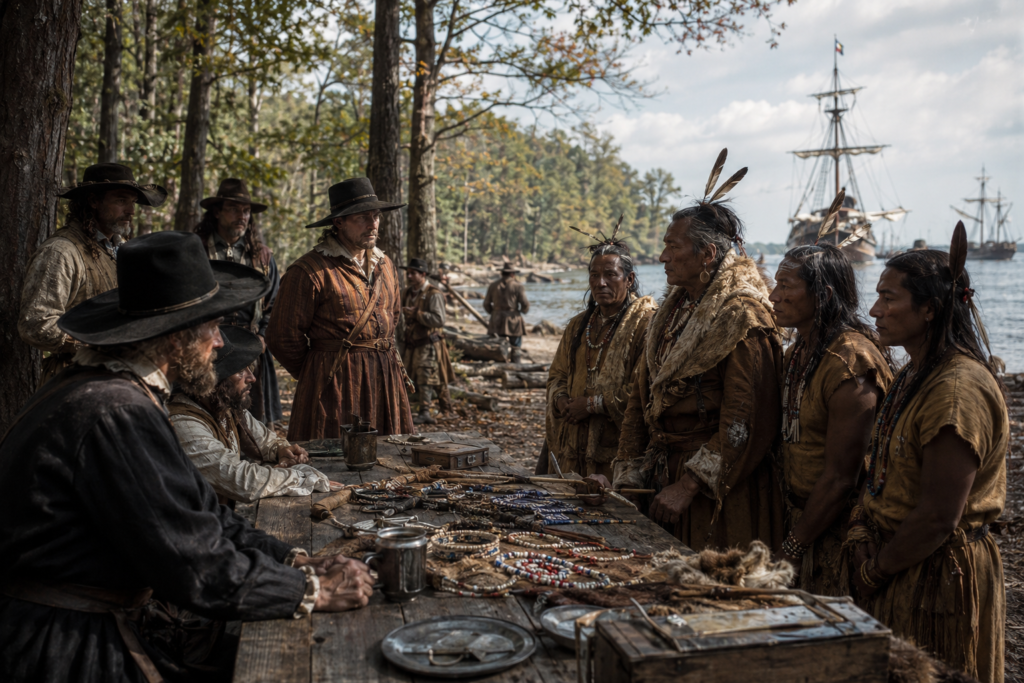
Europeans arrived in North America, met Native Americans on Manhattan Island, and supposedly bought the entire island for a handful of beads worth about twenty-four dollars. The story usually gets told as a joke about one side being clever and the other side being hopelessly naive.
For generations, the phrase “they bought Manhattan for beads” became shorthand for one of the greatest real estate deals in history. It sounds absurd enough to survive forever because it flatters modern assumptions about intelligence, money, and civilization. Europeans appear calculating and sophisticated. Indigenous people appear confused and easily manipulated.
The real story is much darker, more complicated, and far more revealing about power.
Once you start examining the actual historical context, the famous narrative begins collapsing almost immediately. The “beads” story oversimplifies the transaction, misunderstands Indigenous concepts of land use, ignores the enormous imbalance of military and political power, and reflects centuries of eurocentric storytelling that treated Native societies as primitive obstacles instead of organized civilizations.
The deeper truth is uncomfortable.
Most historical negotiations between colonizers and Indigenous populations were never negotiations between equals. Fear, disease, weapons, trade dependence, and political pressure shaped nearly every interaction long before formal treaties were signed.
The Manhattan story survived because simple myths are easier to repeat than complicated realities.
The Famous Story Everyone Knows
The traditional version of the story usually goes something like this:
In 1626, Dutch colonists supposedly purchased Manhattan Island from Native Americans for goods worth sixty guilders, often converted later into roughly twenty-four U.S. dollars. Over time, storytellers simplified the goods into “beads and trinkets,” turning the exchange into a symbol of Indigenous people failing to understand value.
The image became deeply embedded in Western culture.
Schoolbooks repeated it. Newspapers referenced it. Politicians and writers used it as shorthand for foolish bargaining. The story fit perfectly into colonial narratives portraying Europeans as economically advanced and Native societies as unsophisticated.
The problem is that several parts of the story are either misleading, oversimplified, or impossible to verify completely.
Historians still debate important details surrounding the transaction itself, including:
- Which Indigenous group actually participated
- Whether the land was understood as permanently sold
- What the exchanged goods really included
- Whether multiple overlapping land claims existed
- How much coercion or intimidation influenced negotiations
- Whether both sides even understood the agreement in the same way
That uncertainty matters because the simplified version erases the complexity of Indigenous political systems and land relationships.
It also ignores something even more important: power imbalance.
What Was Actually Exchanged?
The main historical source for the Manhattan purchase comes from a 1626 letter written by Dutch merchant Pieter Schagen. In the letter, Schagen stated that Manhattan had been purchased for sixty guilders worth of goods.
That single line eventually became one of the most famous property stories in world history.
But the letter never specifically mentioned beads.
Over time, later writers transformed “goods” into the far more dramatic image of shiny trinkets exchanged for one of the most valuable pieces of land on Earth. Historians believe the traded items likely included a mixture of manufactured goods useful within existing trade networks.
Possible items included:
- Metal tools
- Cloth
- Knives
- Axes
- Kettles
- Decorative trade items
- Glass beads
- Weapons or ammunition
Some of these items carried enormous value within Indigenous trade systems at the time. European manufactured metal goods especially could drastically alter labor efficiency, hunting capacity, and regional trade relationships.
This is where modern misunderstandings begin appearing.
People often assume Indigenous societies simply failed to understand economic value. But value always depends partly on context. A steel axe inside a pre-industrial environment could transform daily life far more dramatically than modern people appreciate.
Cultures assign value differently depending on needs, technology, and social structures.
European observers often interpreted those differences as stupidity instead of difference.
That pattern repeated constantly throughout colonial history.
Did Indigenous People Even Think Land Could Be Sold?
One of the biggest problems with the traditional Manhattan story is the assumption that both sides understood land ownership the same way.
They almost certainly did not.
Many Indigenous societies in North America approached land through systems based more on shared usage rights, seasonal access, stewardship, alliances, and overlapping territorial relationships rather than absolute permanent ownership in the European legal sense.
That does not mean Native societies lacked concepts of territory or property. They absolutely defended land, recognized boundaries, and understood political control. But the European idea of permanently transferring total ownership through written contracts often did not align cleanly with Indigenous frameworks.
This created enormous confusion during colonial expansion.
European settlers frequently interpreted agreements as complete land transfers. Indigenous groups may have interpreted some arrangements more as shared access agreements, diplomatic alliances, or limited usage permissions.
The Manhattan transaction likely existed inside that confusion.
Complicating matters further, historians believe the Lenape people associated with Manhattan may not have been the only group claiming rights over the island. Some researchers argue the Canarsie people involved in negotiations may not have possessed sole authority over the territory from the perspective of neighboring groups.
That possibility changes the story entirely.
Instead of a simple “purchase,” the event begins looking more like a collision between incompatible systems of law, property, diplomacy, and power.
The Role of Fear and Power
The traditional Manhattan story also ignores the atmosphere surrounding early colonial encounters.
By the early seventeenth century, Indigenous populations across parts of North America were already experiencing catastrophic disruption from European contact. Diseases introduced through trade and colonization had devastated many Native communities long before large numbers of settlers even arrived directly in certain regions.
Violence and military pressure also shaped interactions constantly.
European colonial powers arrived with ships, firearms, expanding settlements, and ambitions for territorial control. Indigenous leaders navigating these encounters were not operating inside calm business negotiations between equal partners.
They were dealing with unpredictable foreign powers whose military technology and long-term intentions remained uncertain.
Fear absolutely mattered.
This is one reason the “they sold Manhattan for beads” story feels so misleading today. It frames the exchange almost like a comedy instead of recognizing the broader colonial pressure surrounding it.
Historical negotiations become distorted when one side possesses overwhelming advantages in:
- Weapons
- Maritime power
- Disease immunity
- Economic networks
- Written legal systems
- Military reinforcement capacity
- Financial resources
Under those conditions, “agreements” rarely function as fully equal negotiations.
The imbalance itself shapes outcomes before anyone even sits down to talk.
Eurocentrism and the Myth of Indigenous Naivety
For centuries, European and American writers often described Indigenous societies through deeply eurocentric assumptions.
Native cultures were frequently portrayed as childlike, irrational, primitive, or economically unsophisticated compared to European civilization. The Manhattan story fit perfectly inside that framework because it reinforced the idea that Europeans naturally understood value better.
But this interpretation says more about colonial attitudes than Indigenous intelligence.
Different societies simply prioritized different forms of value.
Many Native American communities built highly sophisticated trade systems long before European arrival. Complex regional exchange networks connected enormous areas of North America using shells, furs, copper, food products, crafted goods, and diplomatic relationships.
The Lenape themselves participated in active trade economies.
Europeans often misunderstood these systems because they measured sophistication primarily through European institutions like centralized banking, written contracts, and private property markets.
That misunderstanding still happens today.
Cultures frequently dismiss other societies as irrational simply because they organize value differently. Throughout history, dominant powers repeatedly interpreted unfamiliar economic systems as evidence of inferiority.
The Manhattan myth became one more example of that pattern.
Manhattan Before New York
Another reason the famous story distorts reality is because people project modern Manhattan backward into the seventeenth century.
Today Manhattan represents extraordinary financial value.
Skyscrapers, global banking, luxury real estate, Wall Street, and billions of dollars in property wealth transformed the island into one of the most economically important urban spaces on Earth.
But in 1626, nobody viewed Manhattan through that lens.
To the Dutch, the island represented strategic trading potential connected to fur commerce and colonial expansion. To Indigenous communities, the land carried importance through hunting, fishing, seasonal use, transportation routes, and settlement networks.
Nobody involved could fully imagine what Manhattan would eventually become.
This hindsight effect changes how modern people interpret the transaction.
The story feels absurd largely because people compare seventeenth-century trade goods against twenty-first-century Manhattan real estate values. But historical actors operate inside their own moment, not future outcomes they cannot predict.
That perspective does not erase colonial exploitation.
It simply makes the situation more historically honest.
Manhattan vs. Modern Economic Myths
The Manhattan story survived partly because modern societies love simplified economic morality tales.
People enjoy narratives where one side wins brilliantly while the other loses foolishly. These stories create satisfying emotional clarity even when history itself is far messier.
| Simplified Myth | Historical Reality |
|---|---|
| Indigenous people were tricked by beads | The exchange likely involved many useful trade goods |
| Europeans understood value better | Both societies valued different things |
| The transaction was a simple land sale | Land concepts probably differed significantly |
| Both sides negotiated equally | Massive power imbalance existed |
| Manhattan was obviously priceless | Its future value was unknowable in 1626 |
| Indigenous societies were naive | Native trade systems were highly developed |
The table reveals why historians increasingly challenge the traditional version of the story.
The issue is not whether some exchange happened. It almost certainly did.
The issue is how later generations transformed a complicated colonial encounter into a simplistic myth reinforcing ideas about European superiority.
That transformation mattered politically.
Colonial societies often justified territorial expansion partly by portraying Indigenous populations as incapable of properly managing land, commerce, or political systems. Stories like Manhattan for beads helped reinforce those assumptions culturally.
What Happened to the Lenape?
The most tragic part of the Manhattan story is what happened afterward.
The Lenape people did not disappear immediately after European settlement expanded. But over time, colonial growth pushed Indigenous populations further from ancestral territories through warfare, legal pressure, displacement, broken treaties, and expanding settlement.
Dutch control eventually gave way to English control after 1664 when New Amsterdam became New York.
As colonial populations increased, Indigenous political power around Manhattan collapsed rapidly.
The island itself transformed beyond recognition.
Forests disappeared.
Settlements expanded.
Trade ports grew.
Financial institutions emerged.
What began as colonial outposts eventually evolved into one of the world’s dominant economic centers.
Meanwhile, the people most associated with the original land faded almost entirely from the popular version of the story.
That absence is revealing.
The simplified myth remembers the “deal” but forgets the long-term consequences surrounding it.
What the Manhattan Story Really Teaches
The real lesson behind the Manhattan story is not that Indigenous people failed to understand value.
If anything, the deeper lesson is that power shapes economic outcomes far more than intelligence alone.
Throughout history, stronger societies repeatedly imposed their systems, laws, and economic assumptions onto weaker populations. Military superiority, financial resources, technology, and political organization often determine which side controls the narrative afterward.
The Manhattan myth survived because colonial powers eventually controlled the institutions writing history.
That does not mean every colonial interaction involved direct deception at every moment. Human relationships are always more complicated than that. Trade, alliances, diplomacy, and cooperation absolutely existed between Europeans and Indigenous groups.
But those interactions unfolded inside enormous structural inequality.
That context changes everything.
The story also reveals how easily societies mock unfamiliar systems of value. Eurocentric narratives long treated Indigenous cultures as economically irrational simply because they organized property, trade, and land relationships differently.
Modern readers increasingly recognize how misleading that perspective was.
Conclusion
The famous “Manhattan for beads” story survived for centuries because it reduces a complicated colonial encounter into a simple joke.
But history rarely works that cleanly.
The real story involved cultural misunderstanding, conflicting ideas about land, trade relationships, colonial pressure, military imbalance, and expanding European power reshaping North America permanently.
Most importantly, it involved human beings trying to navigate radically unequal circumstances.
The Indigenous communities connected to Manhattan were not foolish caricatures wandering blindly into history. They were societies confronting foreign powers carrying unfamiliar technology, diseases, economic systems, and territorial ambitions.
Once you understand that context, the famous story changes completely.
It stops sounding like a comedy about cheap beads and starts looking much more like what it really was: one small moment inside a massive struggle over power, land, survival, and whose version of reality would eventually dominate history itself.
The famous Manhattan purchase story reveals more about colonial power and eurocentric myths than about Indigenous intelligence or economic value.