
Introduction
Empires rarely survive through military force alone.
Armies can conquer territory, but controlling people for generations requires something deeper. Laws matter. Symbols matter. Rituals matter. And perhaps most importantly, money matters.
Ancient Rome understood this extremely well.
When the Roman Empire expanded into Judea, the conflict was never only about land or taxation. Religion sat at the center of daily life in Jerusalem, and the Romans quickly realized something dangerous: whoever controlled the economy around the Temple also influenced the spiritual and political stability of the region.
That is why coins became far more than currency.
They became instruments of power.
Roman authorities understood that religious identity and economic systems were tightly connected inside ancient Jerusalem. Controlling taxation, temple payments, and the circulation of certain coins allowed the empire to exert pressure far beyond ordinary commerce.
The story feels ancient on the surface, but the underlying logic still feels modern.
Political institutions, religious organizations, and financial systems remain deeply interconnected in many societies today. Sometimes the relationship is subtle. Other times it becomes extremely obvious, especially when powerful institutions use spiritual authority, economic dependency, or collective belief to shape public behavior.
Rome recognized something many empires eventually discover:
Controlling money often means controlling social order itself.
Why Jerusalem Was So Sensitive to Roman Rule
By the first century BCE, Jerusalem was not simply another provincial city inside the expanding Roman world.
It was one of the most religiously and politically sensitive locations in the eastern Mediterranean.
For Jewish communities, the Temple in Jerusalem represented the spiritual center of religious life. Pilgrimage, sacrifice, taxation, law, and identity all revolved around it. The Temple was not just a building for worship. It also functioned as an economic institution managing enormous flows of wealth, offerings, and political influence.
That combination made Roman control extremely delicate.
Rome often allowed conquered regions to preserve parts of their local religious traditions as long as imperial authority remained intact. This strategy reduced rebellion while still allowing Rome to collect taxes and maintain political dominance.
But Judea proved unusually difficult to manage.
Religious tensions constantly overlapped with political resentment. Roman governors imposed taxation systems viewed by many locals as exploitative and humiliating. Cultural clashes deepened as imperial symbols and pagan imagery collided with Jewish religious sensitivities.
Money became one of the central battlegrounds.
Coins carried political messages everywhere in the Roman world. Emperors printed their faces, titles, military victories, and religious symbolism directly onto currency circulating daily through markets and cities.
In Jerusalem, that created immediate problems.
Many Jewish communities strongly opposed graven images associated with idolatry. Roman coins featuring emperors or pagan symbolism therefore carried religious implications far beyond simple trade.
The empire was not just introducing currency.
It was introducing authority.
The Temple Tax and Sacred Economics
One of the most important financial systems in Jerusalem involved the Temple tax.
Jewish men across many regions traditionally contributed a half-shekel tax supporting Temple operations. This payment funded sacrifices, maintenance, religious services, and broader institutional functions connected to worship.
The Temple therefore operated partly like a financial center as well as a spiritual one.
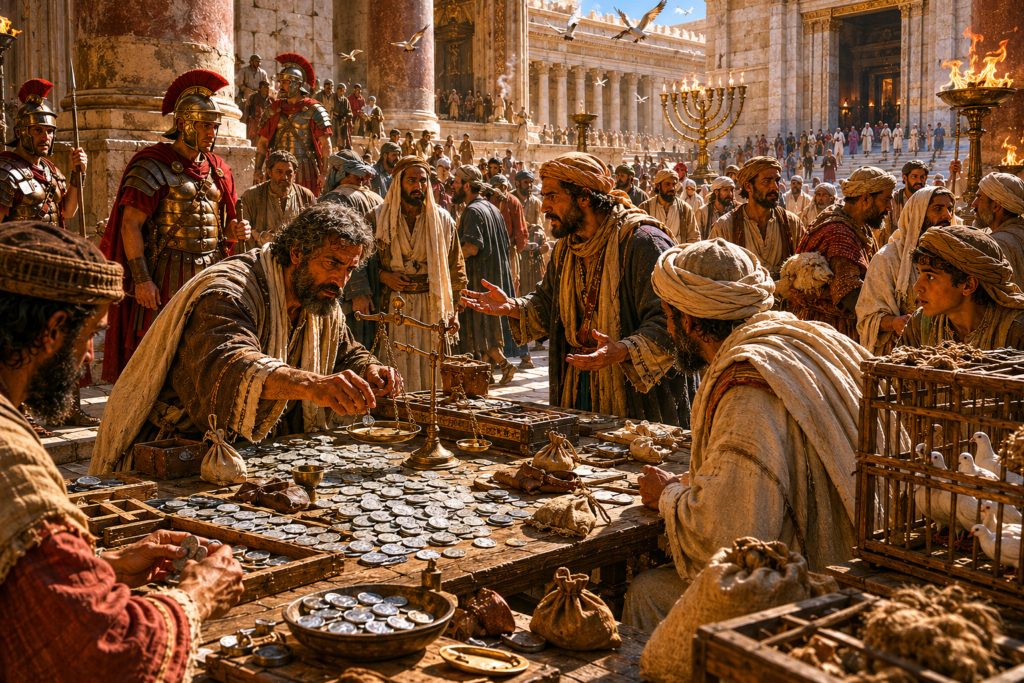
Large amounts of silver flowed into Jerusalem through pilgrimage and taxation networks. Money changers became essential because many foreign coins circulating across the Roman Empire did not meet religious standards required for Temple payments.
This is where sacred economics emerged very clearly.
The preferred currency for Temple taxes often involved Tyrian shekels, silver coins originally minted in the Phoenician city of Tyre. Ironically, these coins contained pagan imagery, including depictions associated with the god Melqart, but they were valued because of their unusually high silver purity.
Purity mattered economically and religiously.
That created a strange contradiction.
Even while resisting Roman political control and certain forms of pagan symbolism, Temple authorities still relied heavily on specific silver currencies trusted for consistent metal content.
Money and religion became inseparable.
| Element | Role in Jerusalem |
|---|---|
| Temple Tax | Financial support for Temple operations |
| Tyrian Shekels | Preferred silver coins for payments |
| Money Changers | Converted foreign currency into accepted forms |
| Roman Coinage | Symbol of imperial political authority |
| Temple Economy | Combined religious and economic power |
| Pilgrimage Trade | Generated massive financial activity |
The existence of money changers around the Temple later became historically famous because of one dramatic moment described in Christian scripture: Jesus overturning the tables of the money changers during Passover.
That scene reveals how economically charged the Temple environment had become.
Religion, money, and political authority were deeply intertwined.
Why Rome Cared About Coins So Much
Modern people often underestimate how powerful coins were in the ancient world.
Today most money exists digitally. Transactions happen invisibly through banking systems, apps, and financial databases. But in antiquity, coins functioned as one of the most constant visual reminders of state authority.
Every transaction reinforced political messaging.
Roman emperors understood this perfectly.
Coins regularly displayed:
- Imperial portraits
- Military victories
- Religious symbolism
- Political slogans
- Claims of divine legitimacy
- Messages about loyalty and order
For many ordinary people, coins represented the most direct physical contact with imperial power they experienced daily.
That mattered enormously inside politically unstable regions like Judea.
The Roman Empire did not simply want tax revenue. It wanted legitimacy. Coins helped normalize imperial presence psychologically by embedding Roman imagery directly into economic life.
This is why controlling currency became strategically important.
Economic systems shape behavior quietly. People may resist armies openly, but they still need food, trade, taxation systems, and functioning markets to survive. Over time, monetary control influences daily life more consistently than military force alone.
That logic still exists today.
Modern governments and institutions understand that economic leverage often shapes societies more effectively than direct coercion. Debt systems, central banking, sanctions, inflation control, and financial dependency all influence behavior on massive scales.
Rome used simpler tools, but the strategic principle was remarkably similar.
The Money Changers and the Temple Conflict
One of the most famous economic scenes in religious history involves the money changers inside the Temple complex.
According to the New Testament, Jesus entered the Temple and violently disrupted the activities of merchants and money changers, accusing them of corrupting a sacred space.
The scene is often interpreted purely as a moral or spiritual moment.
But economically, it was explosive.
The Temple economy had become enormous by the first century CE. Pilgrims arriving from across different regions needed approved currency for sacrifices and tax obligations. Money changers facilitated these exchanges, often charging fees and profiting from conversion rates.
Animal merchants also sold sacrificial offerings inside the broader Temple system.
For critics, this created the appearance that religious devotion had become entangled with financial exploitation.
That criticism still resonates today.
Many modern societies continue debating the relationship between spiritual authority and money. Religious institutions frequently accumulate political influence, property, donations, and financial power while presenting themselves as moral authorities.
The overlap between faith and economics never fully disappeared.
Ancient Jerusalem simply exposed the relationship more visibly than most places.
Rome, Rebellion, and Economic Control
Tensions between Judea and Rome eventually exploded into open revolt.
The First Jewish–Roman War began in 66 CE after years of political resentment, taxation disputes, religious tensions, and anti-Roman resistance. Jerusalem became the center of the conflict.
Economic control played a major role throughout the rebellion.
Revolutionary groups even minted their own coins during the revolt, directly challenging Roman authority. These coins carried Hebrew inscriptions and religious symbolism emphasizing liberation and national identity.
That detail reveals something important.
Issuing currency is one of the strongest declarations of sovereignty any political movement can make.
By creating alternative coinage, Jewish rebels were not only funding resistance. They were symbolically rejecting Roman legitimacy itself.
Rome understood the threat immediately.
In 70 CE, Roman forces under Titus destroyed the Second Temple after a brutal siege of Jerusalem. The destruction permanently transformed Jewish religious life and scattered much of the population across the empire.
The Temple tax itself was later redirected by Rome into the Fiscus Judaicus, a tax imposed on Jews throughout the empire and redirected toward the Temple of Jupiter Capitolinus in Rome.
The symbolism was devastating.
Rome effectively transformed a sacred religious obligation into a financial reminder of imperial domination.
Sacred Coins vs. Modern Economic Power
The story of Jerusalem’s sacred coinage reveals how closely money and belief systems remain connected throughout history.
Modern societies often pretend economics operates separately from ideology or cultural identity. In reality, financial systems constantly reinforce broader structures of authority.
| Ancient Rome | Modern Systems |
|---|---|
| Coins carried imperial propaganda | Currency reflects national legitimacy |
| Temple taxes reinforced religious systems | Tax systems reinforce state power |
| Money changers controlled accepted currency | Banks control financial access |
| Religious institutions held economic influence | Large institutions still shape financial behavior |
| Monetary control supported empire | Economic leverage supports modern geopolitical power |
One major difference today is visibility.
Ancient people physically saw imperial symbols every time coins changed hands. Modern systems feel more abstract because financial power often operates digitally and institutionally rather than visually.
But the underlying principle remains surprisingly similar.
Control over economic systems shapes societies quietly and continuously.
Military force can conquer territory temporarily. Economic systems shape behavior every single day.
That is why empires, governments, corporations, and religious institutions consistently fight for financial influence.
What This Story Reveals About Power
The history of sacred coins in Jerusalem reveals that economic control often matters more than brute force over the long term.
Armies create fear quickly.
Economic systems create dependence slowly.
Rome understood this deeply. The empire recognized that controlling taxation, accepted currency, trade infrastructure, and religious finances allowed imperial authority to penetrate everyday life far more effectively than military occupation alone.
That insight still defines modern power structures.
Governments, banks, corporations, and religious institutions all compete partly through economic influence because money shapes behavior constantly. People may reject political messages openly while still depending economically on the systems delivering them.
The story also exposes how difficult it is to separate religion from economics completely.
Spiritual institutions require funding, infrastructure, and organizational systems. Once money enters the equation, power dynamics inevitably follow. Throughout history, religious legitimacy and economic authority repeatedly reinforced one another.
Ancient Jerusalem simply made the relationship impossible to ignore.
Conclusion
The sacred coins of Jerusalem were never just pieces of silver.
They represented a collision between empire, religion, identity, and economic power inside one of the most politically sensitive cities of the ancient world.
Rome understood that controlling money meant influencing far more than trade. Currency shaped taxation, loyalty, legitimacy, and religious life itself. The empire recognized that stable control rarely comes only from military force.
It comes from embedding authority into everyday systems people cannot easily escape.
That is why coins mattered so much.
They carried power silently from hand to hand across markets, temples, and entire societies.
The deeper lesson still feels surprisingly modern.
Economic systems do far more than move wealth. They shape belief, reinforce institutions, and quietly define who holds power over daily life.
Ancient Jerusalem simply revealed that connection more openly than most societies ever do.
The sacred coins of Jerusalem reveal how Rome used money, taxation, and religious economics to strengthen imperial control over Judea.