
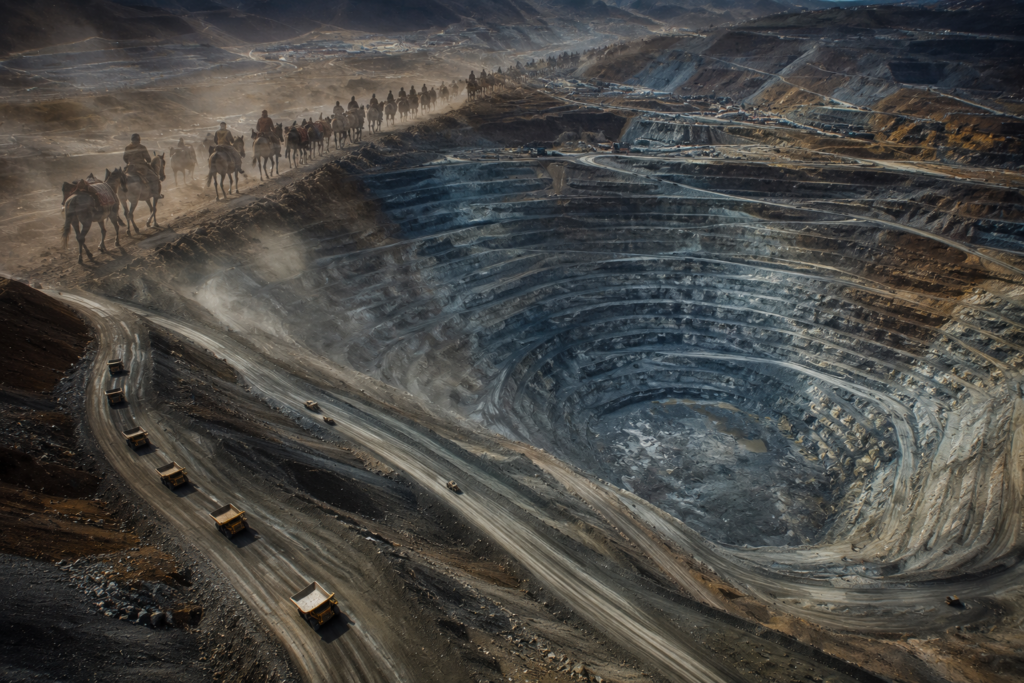
Most people have never seen a rare earth mine.
They have never held a piece of neodymium in their hands. They probably could not name a single rare earth element without looking it up. Yet these obscure materials help power smartphones, electric vehicles, wind turbines, advanced military systems, industrial robots, data centers, and countless other technologies that define modern life.
In recent years, China has reminded the world just how important these materials really are.
Through a series of export restrictions and regulatory controls, Beijing has demonstrated a reality that many policymakers spent decades ignoring: if one country controls a critical resource, everyone else becomes vulnerable.
The story feels modern.
In some ways, however, it is ancient.
Almost two thousand years ago, the Roman Empire learned a remarkably similar lesson. Rome possessed enormous military power, vast wealth, and control over much of the known world. Yet even Rome discovered that strength has limits when another society controls something you desperately need.
For Rome, that resource was horses.
For the modern world, it may be rare earth elements.
The technologies changed.
The strategic logic did not.
The Materials Most People Never Think About
Rare earth elements sound exotic, but they are embedded throughout modern life.
They help create powerful magnets used in electric motors. They improve battery systems. They support advanced electronics, precision manufacturing, defense technologies, and renewable energy infrastructure.
Ironically, most rare earth elements are not particularly rare.
The challenge is production.
Mining, refining, and processing these materials requires specialized infrastructure, technical expertise, environmental management, and enormous capital investment. Building an alternative supply chain can take years, sometimes decades.
This distinction matters.
The world’s problem is not that rare earths do not exist elsewhere.
The problem is that replacing established production systems is extraordinarily difficult.
For many years, China invested heavily in developing these capabilities.
The result was a level of dominance few industries ever achieve.
How China Became So Important
China did not acquire its position overnight.
For decades, Chinese companies and government planners expanded mining operations, processing facilities, refining capabilities, and industrial expertise. As global competition intensified, many countries found it cheaper to rely on Chinese production rather than maintain domestic alternatives.
From a short-term perspective, the arrangement seemed logical.
Companies reduced costs.
Consumers benefited from lower prices.
Governments worried about other priorities.
Over time, however, efficiency created dependency.
A familiar pattern emerged.
The more successful the system became, the harder it became to replace.
Many supply chains gradually evolved around assumptions that Chinese production would always remain available.
History suggests such assumptions rarely survive forever.
Rome Faced a Similar Problem
The comparison becomes clearer when examining one of Rome’s lesser-known strategic vulnerabilities.
The Roman military depended heavily on horses.
Cavalry units required them. Communications required them. Transportation required them. Logistics required them. Military effectiveness often depended on maintaining access to quality horse populations.
Yet the best horses frequently came from regions beyond direct Roman control.
Many originated among steppe peoples and neighboring societies that possessed generations of expertise in breeding, training, and raising animals suited for warfare.
Rome could not simply manufacture replacements.
It needed access.
This reality created one of the most important trade relationships in ancient history.
China’s Tang Dynasty later developed the famous Silk-for-Horses trade, exchanging highly valued silk for the military animals it needed. Rome faced similar strategic realities throughout various periods of its history.
The lesson was simple.
Sometimes the most powerful empire in the world still depends on resources controlled by someone else.
Why Resource Dependence Matters
Your answer focused on the difficulty of replacement.
That is exactly where strategic power often emerges.
A resource becomes truly valuable when three conditions exist:
- It is important.
- It is difficult to replace.
- Alternatives take a long time to develop.
Rare earth elements increasingly fit this description.
The challenge is not simply finding another supplier.
The challenge is rebuilding an entire ecosystem.
New mines require permits.
New refineries require investment.
New expertise requires training.
New logistics networks require development.
Everything takes time.
And time is often the most expensive resource in geopolitics.
The Roman Empire learned this repeatedly.
Military strength could solve many problems.
It could not instantly create resources that required generations to develop.
The Myth of Self-Sufficiency
One reason this story matters is that it challenges a common assumption.
People often imagine powerful nations as self-sufficient.
Reality tends to be messier.
History is full of dominant powers that depended on external suppliers.
Britain needed cotton.
Industrial Europe needed rubber.
Modern economies need semiconductors.
Advanced technology industries need rare earth processing.
Globalization increased efficiency precisely because countries specialized in different things.
The downside is obvious.
Specialization creates dependency.
Dependency creates vulnerability.
The trade-off has existed for centuries.
The modern world simply experiences it on a larger scale.
Why Substitution Is So Difficult
At first glance, replacing a supplier sounds straightforward.
Find another source.
Build another mine.
Problem solved.
In practice, economic systems rarely work that way.
Consider how long it takes to develop a major mining operation:
| Stage | Typical Timeline |
|---|---|
| Exploration | Years |
| Environmental review | Years |
| Permitting | Years |
| Construction | Years |
| Production ramp-up | Years |
Even when governments move aggressively, the process remains slow.
This creates an important asymmetry.
Restrictions can happen quickly.
Replacement often cannot.
That imbalance gives resource suppliers leverage.
The same principle applied throughout history.
Building a cavalry force required years.
Breeding quality horses required even longer.
The empire that controlled immediate supply possessed advantages that military strength alone could not eliminate.
The Strategic Resource Pattern
One of the most interesting patterns in economic history is how often strategic resources change.
The underlying logic remains constant.
Different eras simply assign importance to different materials.
| Era | Strategic Resource |
|---|---|
| Bronze Age | Tin |
| Classical Period | Horses |
| Age of Exploration | Spices |
| Industrial Revolution | Coal |
| Twentieth Century | Oil |
| Twenty-First Century | Data, semiconductors, rare earths |
The specific resource changes.
The geopolitical behavior remains surprisingly similar.
Nations seek access.
Competitors seek alternatives.
Prices fluctuate.
Supply chains adapt.
Dependency becomes visible.
Then the cycle repeats.
What Minecraft Actually Gets Right
Your Minecraft example may sound funny, but it captures an important economic truth.
Players quickly learn that some resources matter far more than others.
Certain materials unlock tools, technologies, transportation, or strategic advantages that become difficult to replicate without them.
Scarcity alone does not create value.
Usefulness creates value.
Scarcity amplifies it.
The real world works similarly.
Rare earth elements matter because they sit inside technologies society increasingly depends on. If nobody needed them, their strategic importance would disappear overnight.
The same was true for horses in the ancient world.
The resource mattered because the system depended on it.
What Most People Miss About Resource Power
Many discussions about geopolitical competition focus on military strength.
Military power matters.
History shows, however, that controlling critical resources often produces influence that armies alone cannot guarantee.
Rome discovered this.
Britain discovered this.
Modern powers continue discovering it.
A nation can possess immense military capabilities while remaining vulnerable in areas where it lacks essential inputs.
This is why governments increasingly pay attention to supply chains.
Supply chains are not merely economic systems.
They are strategic systems.
Sometimes they determine what an economy can build, what a military can deploy, and how quickly a nation can respond during crises.
The importance of rare earths extends far beyond mining.
The real issue is dependency.
The Lesson Rome Learned
Rome’s greatest strength was its ability to conquer.
Its greatest frustration was realizing that conquest could not solve every problem.
Some advantages took decades to build.
Some expertise could not be copied quickly.
Some resources remained concentrated elsewhere.
Modern governments face similar realities.
They can invest billions of dollars.
They can subsidize domestic production.
They can encourage new industries.
What they cannot do is compress ten years of industrial development into six months.
That is why China’s position matters.
Not because alternatives are impossible.
Because alternatives are slow.
And strategic leverage often exists in the gap between those two facts.
Conclusion
China’s rare earth restrictions highlight a lesson that powerful societies have encountered throughout history: controlling an essential resource can sometimes matter as much as controlling armies, territory, or financial wealth.
The Roman Empire learned this when it depended on resources and expertise beyond its borders. Modern economies are learning it again through rare earth elements, semiconductor supply chains, and other critical industries that support contemporary technology.
The story is not really about mining.
It is about dependency.
Whenever a system becomes dependent on something difficult to replace, whoever controls that resource gains influence. The resource itself may change from horses to oil to rare earth elements, but the underlying mechanism remains remarkably consistent.
History rarely repeats exactly.
But it often reminds us that power belongs not only to those who need resources.
It also belongs to those who control them.
References
- Frankopan, Peter. The Silk Roads: A New History of the World. Bloomsbury Publishing, 2015.
- Millward, James A. The Silk Road: A Very Short Introduction. Oxford University Press, 2013.
- Graff, David A. Medieval Chinese Warfare, 300–900. Routledge, 2002.
- U.S. Geological Survey (USGS). Rare Earth Elements Statistics and Information.
- Congressional Research Service. China’s Control of Rare Earth Supply Chains and Strategic Implications.
Meta Description:
China’s rare earth restrictions reveal a timeless lesson: the most powerful economies can still become vulnerable when critical resources are controlled by someone else.