
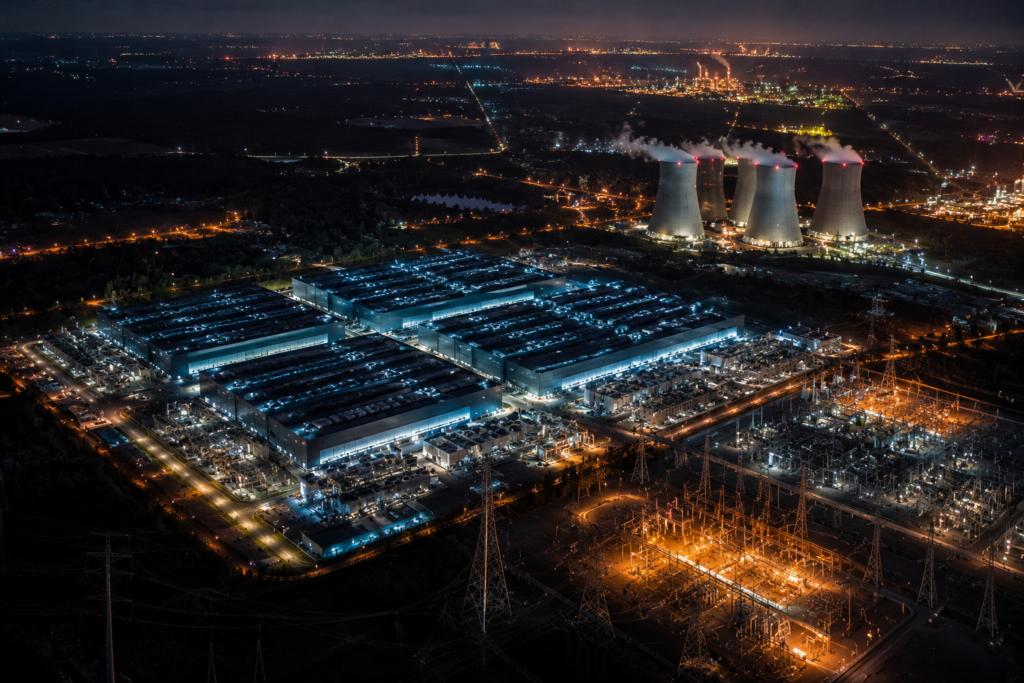
Most discussions about artificial intelligence focus on the obvious questions.
Will it replace jobs?
Which companies will win?
How much money will be made?
How powerful will the models become?
These are important questions, but they all share a common assumption. They treat AI as something digital, almost weightless. A technology that exists in the cloud, detached from the physical world.
The reality is very different.
Every AI prompt travels through physical infrastructure. Every generated image requires electricity. Every large language model runs inside massive facilities filled with servers, cooling systems, transformers, backup power equipment, networking hardware, and vast quantities of raw materials extracted from the earth.
The AI boom may feel virtual.
Its costs are surprisingly physical.
History suggests this should not surprise us. Nearly every major economic revolution creates visible winners and invisible costs. The people making money receive attention. The infrastructure enabling that wealth often remains hidden until bottlenecks appear.
The California Gold Rush created fortunes, but it also transformed landscapes, consumed resources, and generated enormous environmental costs. The Industrial Revolution increased productivity dramatically while simultaneously creating pollution, overcrowding, and infrastructure challenges that took decades to address.
Artificial intelligence appears to be following a similar pattern.
The question is not whether AI will change the world.
The question is who will ultimately pay for the infrastructure required to support it.
The Illusion of a Weightless Technology
One reason people underestimate the costs of AI is that software generally feels different from physical industries.
When someone uses a search engine, streams a movie, or asks an AI assistant a question, the experience appears effortless. There are no smokestacks, factories, railroads, or mines visible from the user’s perspective.
Everything happens behind the screen.
This creates a powerful illusion.
The illusion is that digital services require minimal resources.
In reality, modern technology increasingly depends on infrastructure operating at enormous scale. Cloud computing, streaming platforms, cryptocurrency networks, and AI systems all require physical assets that consume real-world resources.
Artificial intelligence amplifies this trend dramatically.
Training advanced models involves processing extraordinary quantities of data across thousands of specialized chips. Running those models afterward requires continuous access to computing power and cooling systems.
The more successful AI becomes, the greater those demands grow.
That creates costs most users never see.
The Historical Pattern Nobody Notices
One of the most consistent patterns in economic history is that transformative technologies rarely depend on the resource people expect.
When people think about railroads, they imagine locomotives.
The real story involved steel production, coal mining, land acquisition, bridges, tunnels, and financing networks.
When people think about automobiles, they imagine cars.
The real story involved roads, oil production, refineries, highways, parking lots, traffic systems, and suburban development.
When people think about smartphones, they imagine apps.
The real story involves semiconductor fabrication, lithium extraction, rare earth processing, undersea cables, and global logistics networks.
The visible innovation usually receives the attention.
The supporting infrastructure often determines who actually wins.
This is why AI resembles previous economic revolutions more than many people realize.
The technology itself may be revolutionary.
The constraints remain surprisingly familiar.
AI’s Growing Appetite for Electricity
Among all the hidden costs, energy may be the most important.
Modern AI systems consume enormous amounts of electricity during both training and operation. Large data centers already represent significant consumers of power, and demand continues increasing as AI adoption expands.
This creates a challenge many technology companies did not face a decade ago.
For years, software businesses could scale rapidly without worrying much about physical constraints. AI changes that equation. Suddenly, power generation, electrical transmission, and grid capacity become strategic concerns.
This is already influencing corporate decisions.
Data center developers increasingly evaluate locations based on electricity availability rather than simply office space, taxes, or workforce considerations. Utility companies are receiving requests for power levels that would have seemed extraordinary only a few years ago.
In some cases, entire energy projects are being reconsidered because of anticipated AI demand.
That should attract attention.
Whenever a technology begins reshaping infrastructure decisions, something significant is happening.
The Resource Behind the Resource
Your answer focused on mining, and that points toward another overlooked aspect of the AI boom.
Electricity does not appear magically.
Neither do data centers.
The infrastructure supporting AI depends on vast quantities of physical materials:
- Copper
- Aluminum
- Rare earth elements
- Silicon
- Steel
- Concrete
- Lithium
- Specialized semiconductors
Every server requires components.
Every component requires materials.
Every material originates somewhere.
The connection between a chatbot and a mine may seem distant, but the relationship is real. Economic systems often conceal these links because supply chains stretch across multiple countries and industries.
Historically, societies tend to notice these dependencies only when disruptions occur.
That pattern appears repeatedly.
People rarely think about critical resources until they become scarce.
Water: The Cost Almost Nobody Mentions
Electricity receives most of the attention.
Water receives much less.
Yet large data centers frequently require substantial cooling capacity to operate efficiently. Depending on design and location, this can involve significant water usage.
The topic remains controversial because usage varies widely between facilities and technologies. Some operators invest heavily in reducing water consumption. Others depend more heavily on traditional cooling systems.
Regardless of the specific numbers, the broader principle matters.
AI infrastructure does not merely consume digital resources.
It consumes physical resources that communities, industries, and ecosystems also use.
This does not automatically mean AI is harmful.
It simply means trade-offs exist.
Every major technology creates them.
The challenge is recognizing them early enough to make informed decisions.
Why the Labor Question Gets So Much Attention
You mentioned jobs as another major hidden cost.
That concern dominates public discussion for understandable reasons.
People experience employment changes directly.
Electricity grids and supply chains feel abstract.
Job displacement feels personal.
History suggests technological revolutions usually create both disruption and opportunity. The Industrial Revolution eliminated some occupations while creating entirely new industries. Computers replaced certain tasks while generating professions that previously did not exist.
The difficulty lies in timing.
The workers losing jobs rarely experience the transition the same way as economists analyzing long-term trends.
This is one reason technological change often generates social tension.
Benefits and costs rarely arrive simultaneously.
Some groups gain immediately.
Others bear adjustment costs first.
AI appears likely to follow this historical pattern.
The debate is not whether change will occur.
The debate is how quickly, where, and who absorbs the consequences.
The Modern Gold Rush
The AI boom increasingly resembles historical resource booms in one important respect.
The biggest beneficiaries may not always be the companies receiving the headlines.
During gold rushes, many fortunes were made by people selling tools, transportation, lodging, and infrastructure rather than extracting gold directly.
A similar dynamic may be emerging today.
Companies involved in:
- Electricity generation
- Grid equipment
- Cooling technology
- Data center construction
- Semiconductor manufacturing
- Power management
- Industrial infrastructure
often occupy less attention than AI software firms.
Yet these businesses help determine whether expansion remains possible.
History repeatedly shows that supporting infrastructure can become just as important as the innovation itself.
Sometimes more important.
Who Ultimately Pays?
Perhaps the most interesting question is who absorbs these hidden costs.
The answer is rarely simple.
Costs can spread through:
- Higher electricity demand
- Infrastructure investment
- Utility spending
- Government incentives
- Corporate capital expenditures
- Resource extraction projects
In many cases, the people benefiting most directly from a technological revolution are not the same people funding the supporting infrastructure.
This pattern appeared during railway expansion.
It appeared during electrification.
It appeared during highway construction.
And it may appear again with artificial intelligence.
That does not mean the investment is unjustified.
It simply means the distribution of benefits and costs deserves attention.
What History Suggests
Your observation that society becomes blinded by innovation has historical support.
People naturally focus on visible breakthroughs because breakthroughs are exciting. New inventions create optimism, opportunity, and curiosity.
The supporting systems receive less attention.
Yet when historians look back, infrastructure often appears just as important as the invention itself.
The Industrial Revolution depended on coal.
The age of exploration depended on shipbuilding.
Global trade depended on ports.
The internet depended on fiber-optic cables and data centers.
AI appears likely to depend on energy, computing infrastructure, and resource supply chains in similar ways.
That may ultimately become one of the defining economic stories of the decade.
Not the algorithms.
The infrastructure underneath them.
Conclusion
The hidden cost of the AI boom is not a single number or a single resource.
It is the growing realization that artificial intelligence is far more physical than most people assume.
Behind every chatbot, image generator, and AI assistant sits a vast network of power plants, data centers, cooling systems, transmission lines, semiconductor factories, and resource supply chains. These systems consume energy, materials, water, and capital at scales that become increasingly significant as adoption grows.
History suggests this is normal.
Transformative technologies almost always require massive supporting infrastructure. The difference is that people rarely notice those costs during the early stages of a boom. Attention focuses on the innovation itself rather than the systems enabling it.
That may be happening again.
Years from now, historians may remember AI not only as a software revolution but also as one of the largest infrastructure expansions of the twenty-first century.
And the most important story may not be what AI created.
It may be what the world had to build to make AI possible.
References
- International Energy Agency (IEA). Energy and AI Report.
- U.S. Department of Energy. Research on Data Center Energy Consumption.
- Patterson, David et al. Research on AI Computing Infrastructure and Resource Usage.
- Vaclav Smil. How the World Really Works.
- Ed Conway. Material World: The Six Raw Materials That Shape Modern Civilization.
Meta Description:
The AI boom looks digital on the surface, but its hidden costs involve electricity, mining, water, infrastructure, and resource consumption on a massive scale.