
For the past few years, anyone following artificial intelligence heard the same story.
The world needed more chips.
Companies fought for access to advanced semiconductors. Governments worried about Taiwan. Investors studied production numbers from chip manufacturers. News articles described shortages, waiting lists, and billion-dollar orders.
The narrative seemed obvious.
Whoever controlled the chips would control the future of AI.
Then something unexpected happened.
Many of the world’s largest technology companies started discovering that chips were no longer the hardest thing to obtain.
Electricity was.
This shift may become one of the most important economic stories of the decade. Not because AI is running out of computing power, but because the physical world is beginning to impose limits on what was supposed to be a digital revolution.
History suggests this should not surprise us.
Again and again, major technological breakthroughs eventually collide with infrastructure. The invention itself attracts attention. The supporting systems determine how far the revolution can actually go.
Railroads needed coal.
Factories needed electricity.
The internet needed fiber-optic cables.
Artificial intelligence increasingly needs something far less glamorous than software.
It needs enormous amounts of power.
The Problem Nobody Expected
Only a few years ago, discussions about AI focused almost entirely on algorithms.
The challenge was building smarter models.
Then the challenge became obtaining enough advanced chips.
Now a new constraint is emerging.
Power grids.
The reason is simple.
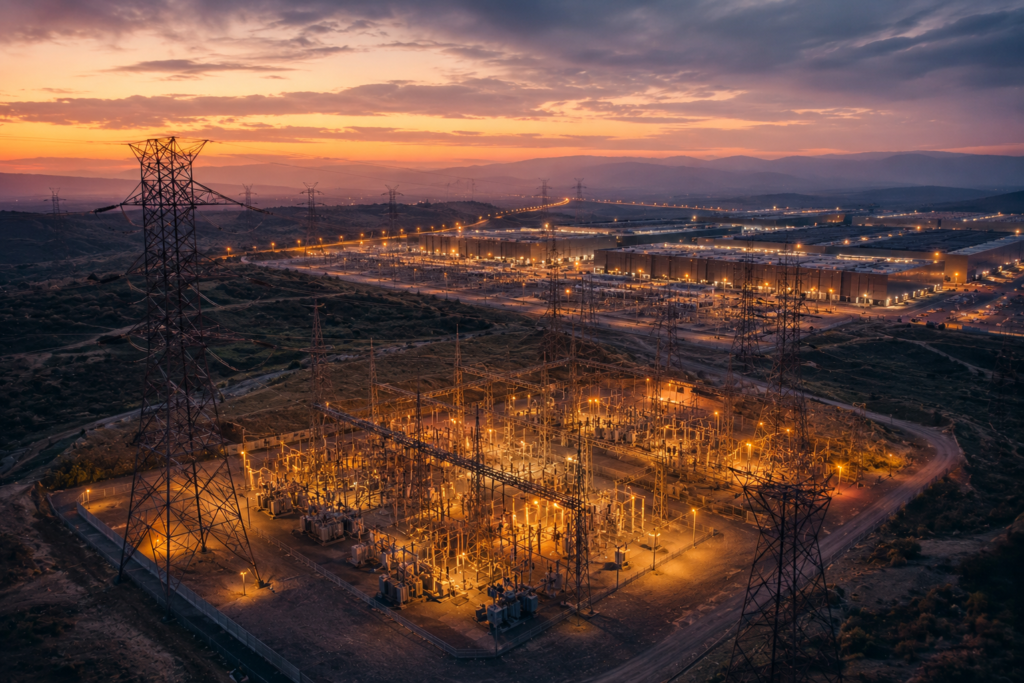
Every AI model runs inside physical facilities packed with servers. Those servers consume electricity continuously. As models become larger and more widely used, power requirements grow alongside them.
A single data center can require as much electricity as a small city.
The newest facilities are becoming even larger.
Technology companies that once worried mainly about software engineers now spend increasing amounts of time discussing transmission lines, substations, transformers, power purchase agreements, and utility capacity.
That would have sounded absurd ten years ago.
Today it is becoming normal.
The Same Pattern Appeared During the Industrial Revolution
Your answer about physical limitations is exactly what history shows.
Major technological revolutions rarely fail because of the invention itself.
They usually encounter bottlenecks elsewhere.
The steam engine was revolutionary.
But railroads still needed steel.
Factories still needed coal.
Workers still needed housing.
Ports still needed expansion.
Economic growth created pressure on systems that previously seemed adequate.
The same process is happening with AI.
People see the chatbot.
They do not see the electrical infrastructure behind it.
Yet that infrastructure increasingly determines how fast expansion can continue.
Technology may move at software speed.
Electricity does not.
Why Companies Are Suddenly Competing for Power
One of the strangest developments of the AI boom is that technology companies are beginning to behave more like industrial companies.
Instead of asking:
“Where can we find engineers?”
Many now ask:
“Where can we find enough electricity?”
This changes everything.
A decade ago, a technology company could place servers almost anywhere.
Today, some data center projects face delays because local grids cannot provide enough power quickly enough.
Building generation capacity takes time.
Building transmission lines takes time.
Building substations takes time.
Meanwhile, AI demand continues growing.
The result is a competition that few people anticipated.
Not for software.
Not for chips.
For electricity itself.
Why Electricity Is Different From Chips
At first glance, electricity seems easier to solve.
Just generate more.
Reality is more complicated.
A semiconductor factory can ship chips across oceans.
Electricity is harder to move.
Power must be generated, transmitted, distributed, and balanced continuously.
A data center cannot simply order ten gigawatts from another continent and expect delivery next week.
Infrastructure matters.
Location matters.
Grid capacity matters.
This creates a challenge that money alone cannot solve immediately.
Companies can spend billions of dollars.
They still cannot accelerate construction projects infinitely.
The physical world moves at its own pace.
The New Gold Rush
Your answer identified energy companies as potential winners.
History suggests that is a reasonable observation.
One of the most common mistakes during economic booms is focusing exclusively on the visible winners.
During the California Gold Rush, many fortunes were built selling equipment, transportation, food, and services rather than mining gold directly.
The same pattern appears repeatedly:
- Railroads created demand for steel.
- Automobiles created demand for oil.
- Smartphones created demand for semiconductors.
- AI is creating demand for electricity.
This does not mean every energy company will benefit equally.
It means the infrastructure layer suddenly becomes much more important.
Whenever an industry becomes essential to a rapidly growing sector, attention follows.
Eventually, investment follows as well.
Why the World Still Runs on Physics
Many people imagine technology as a process of escaping physical limitations.
To some extent, that is true.
Software can automate tasks.
Networks can connect billions of people instantly.
Artificial intelligence can perform work that once required humans.
Yet none of these innovations eliminate physics.
Computers require energy.
Data requires storage.
Networks require hardware.
Even the most advanced AI ultimately operates inside buildings filled with machines consuming real-world resources.
This is one reason your idea of a future where physical constraints disappear remains so appealing.
Human history is partly the story of reducing constraints.
Fire reduced some limitations.
Agriculture reduced others.
Electricity reduced many more.
Every breakthrough expands possibilities.
The challenge is that each breakthrough also creates new bottlenecks.
The Energy Transition Nobody Talks About
Most discussions about energy focus on electric vehicles, climate policy, or renewable generation.
AI is quietly becoming another major factor.
The scale matters.
Data center operators increasingly sign long-term energy contracts. Utilities are revising forecasts. Governments are reassessing future demand projections.
Some regions now evaluate new industrial projects partly through the lens of AI infrastructure.
That would have sounded strange only a few years ago.
The relationship between computing and energy is becoming impossible to ignore.
The more successful AI becomes, the more important electricity becomes.
The Roman Lesson
The connection to history becomes clearer when viewed through the lens of constraints.
The Roman Empire possessed enormous wealth and military power.
Yet it still depended on roads, grain supplies, horses, logistics networks, and physical infrastructure.
Technology never eliminated those dependencies.
It amplified them.
The modern world operates similarly.
Artificial intelligence may represent one of the most advanced technologies ever developed.
Yet its growth increasingly depends on one of civilization’s oldest challenges:
Generating enough energy.
The lesson is not that progress is slowing.
The lesson is that every revolution eventually reveals what it truly depends on.
What Happens Next?
One of the most interesting aspects of this story is that it remains largely invisible to the average person.
Most people will never visit an AI data center.
Most people will never negotiate a power purchase agreement.
Most people will never think about transformer manufacturing capacity.
Yet these issues increasingly influence the future of technology.
This is often how major economic shifts begin.
The public focuses on products.
Industries focus on constraints.
By the time everyone notices the constraint, enormous amounts of money have already moved toward solving it.
Conclusion
For years, the AI race appeared to be about algorithms and semiconductors.
Increasingly, it looks like a race for electricity.
As artificial intelligence expands, technology companies are discovering that computing power alone is not enough. Data centers require vast quantities of energy, and the infrastructure needed to provide that energy cannot be built overnight.
History suggests this is normal.
Every transformative technology eventually collides with the physical systems supporting it. Railroads needed coal. Factories needed electricity. The internet needed fiber-optic networks.
Artificial intelligence needs power.
Lots of it.
The biggest bottleneck may no longer be the chips inside the machines.
It may be the electricity flowing into them.
References
- International Energy Agency (IEA). Energy and AI Report.
- U.S. Department of Energy. Research on Data Center Electricity Demand.
- Vaclav Smil. Energy and Civilization: A History.
- Ed Conway. Material World: The Six Raw Materials That Shape Modern Civilization.
- International Energy Agency. Electricity 2025–2030 Forecasts.
Meta Description:
The biggest challenge facing artificial intelligence may no longer be chips. Growing electricity demand is turning energy infrastructure into the next major AI bottleneck.