
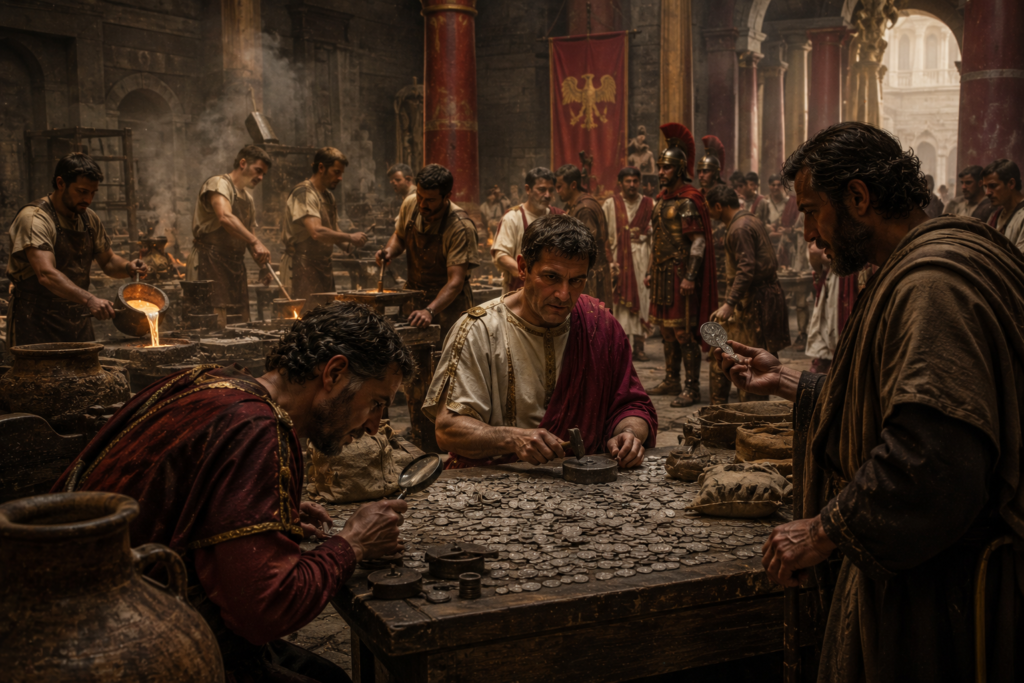
In the year 64 AD, a Roman silver coin contained roughly 94% silver.
By the late third century, some Roman coins contained less than 5%.
The coin looked similar.
The emperor’s face was still stamped on the front.
The official value remained largely unchanged.
But the money itself had been hollowed out.
Most people imagine the fall of Rome as a story of barbarian invasions, military defeats, and political chaos. Those events certainly mattered. Yet hidden beneath the drama was a quieter crisis unfolding over centuries: the slow destruction of Rome’s currency.
Unlike dramatic economic collapses that happen in months or years, Rome’s monetary decline unfolded gradually. One emperor reduced silver content slightly. Another followed. Then another. Each decision seemed manageable in isolation. Together, they created one of history’s most important examples of currency debasement.
What makes the story fascinating is how familiar the logic feels.
Governments facing financial pressure often search for solutions that appear painless in the short term. Raising taxes creates political opposition. Cutting spending creates political opposition. Borrowing has limits.
Changing the money itself can seem easier.
Roman emperors discovered this.
The consequences followed them for centuries.
The story is not merely about ancient coins. It is about incentives, political pressure, and the temptation every government faces when expenses begin growing faster than resources.
The Coin That Built an Empire
At the heart of Rome’s monetary system stood the denarius.
Introduced around 211 BC during the Roman Republic, the denarius became one of the most trusted currencies in the ancient world. It facilitated trade across enormous distances, paid soldiers, financed commerce, and helped integrate territories stretching from Britain to the Middle East.
Trust made the system work.
Merchants accepted Roman coins because they believed the silver content matched the stated value. Soldiers accepted payment because they knew others would recognize the coin’s worth. Taxpayers used the currency because it remained widely accepted throughout the empire.
The system created stability.
For generations, Rome benefited from a relatively reliable monetary foundation supporting one of history’s largest economic zones. Roads connected markets. Ports facilitated trade. Tax systems expanded. Economic specialization increased.
Money helped hold the empire together.
That stability, however, depended on a simple condition.
The silver actually needed to remain in the silver coins.
Why Emperors Started Changing the Money
Running an empire was expensive.
Roman rulers faced enormous financial obligations that rarely disappeared. Armies required payment. Frontier defenses demanded constant maintenance. Infrastructure projects consumed resources. Political rivals needed appeasement. Public works enhanced legitimacy.
The bill never stopped growing.
At first, conquest helped solve the problem.
Victorious armies returned with treasure, slaves, land, and resources. Expansion generated wealth that supported imperial finances. But empires eventually encounter a challenge that many organizations face.
Growth slows.
Expenses remain.
By the first and second centuries AD, Rome’s territorial expansion became more difficult. New conquests produced diminishing returns while administrative and military costs continued rising.
Emperors needed money.
Lots of it.
This created a powerful temptation.
Rather than finding more silver, they could simply use less silver in each coin.
The Art of Debasement
Currency debasement sounds complicated.
In practice, it was remarkably simple.
Suppose a mint possessed enough silver to produce 100 coins. By reducing silver purity slightly, the same amount of metal could produce 120 coins. Reduce purity further, and perhaps it could produce 150 coins.
The government gained more money immediately.
At least on paper.
The process usually occurred gradually because sudden changes risked undermining confidence. Small reductions attracted less attention than dramatic ones. Each emperor could justify modest adjustments based on temporary circumstances.
The pattern became familiar.
A little less silver.
A little more spending.
A little more debasement.
Then repeat.
Over time, the cumulative effect became enormous.
| Period | Approximate Silver Content of the Denarius |
|---|---|
| Early Empire | Over 90% |
| Nero (64 AD) | Around 94% to 85% |
| 2nd Century | Gradual declines |
| 3rd Century | Significant deterioration |
| Late 3rd Century | Often below 5% |
No single reduction destroyed the currency.
The accumulation did.
Why People Did Not Notice Immediately
One of the most interesting aspects of monetary decline is how slowly it often unfolds.
Many Romans did not wake up one morning and suddenly realize their currency had become unreliable. The process spread gradually through prices, wages, trade relationships, and everyday transactions.
This mirrors many inflationary episodes throughout history.
People often recognize symptoms before understanding causes.
A merchant notices supplies becoming more expensive.
A soldier realizes wages buy less.
A farmer demands higher prices.
A craftsman raises fees.
The changes appear disconnected initially.
Only later does the broader pattern become obvious.
This delayed recognition helps explain why debasement remains attractive politically. The benefits arrive immediately while many consequences emerge gradually.
Roman emperors understood the first part.
They often underestimated the second.
Soldiers Became the Center of the Problem
No group influenced Roman monetary policy more than the military.
The empire depended on soldiers for survival. Armies defended borders, suppressed rebellions, supported emperors, and maintained order. Losing military loyalty could end a ruler’s reign very quickly.
This created a difficult incentive structure.
Emperors frequently increased military pay to secure support.
Higher pay required more money.
More money encouraged further debasement.
The cycle fed itself.
Several emperors discovered that paying troops generously improved short-term political stability. The challenge was financing those promises over time.
Instead of solving underlying fiscal problems, many rulers altered the currency itself.
The solution appeared effective initially.
Then prices started responding.
Inflation Arrives
As silver content declined and coin production increased, inflation became increasingly difficult to avoid.
This outcome should not surprise modern readers.
If more currency enters circulation while underlying production remains relatively unchanged, purchasing power tends to fall. Different societies experience the process differently, but the underlying logic remains remarkably consistent.
Romans gradually experienced this reality.
Prices increased.
Confidence weakened.
Merchants became more cautious.
Long-distance trade became more complicated.
People increasingly preferred holding tangible assets rather than currency whenever possible.
The economic damage extended beyond simple price increases.
Trust began eroding.
And trust is the foundation of every monetary system.
When People Stop Trusting the Money
A currency crisis rarely begins with mathematics.
It begins with psychology.
As Romans noticed declining silver content, confidence weakened. Merchants started weighing coins more carefully. Some refused certain issues entirely. Others demanded higher quantities to compensate for lower quality.
The government’s official value became less important than the metal itself.
This represented a serious problem.
Money works best when people accept it without constant verification. Once every transaction requires suspicion, economic efficiency declines dramatically.
Trade slows.
Costs increase.
Uncertainty spreads.
Rome increasingly faced exactly this challenge.
The empire still possessed armies, cities, roads, and institutions. Yet one of the invisible mechanisms supporting economic activity was deteriorating steadily.
That deterioration proved difficult to reverse.
The Third-Century Crisis
The third century became one of the most turbulent periods in Roman history.
Political instability intensified. Civil wars erupted repeatedly. Foreign invasions increased. Economic difficulties multiplied. Emperors rose and fell with alarming frequency.
The currency crisis did not cause all these problems.
But it amplified many of them.
Financial instability made military funding more difficult. Economic uncertainty weakened commerce. Administrative challenges became harder to manage. Confidence in imperial institutions suffered.
The famous antoninianus coin illustrates the problem perfectly.
Introduced during the third century, it was initially intended to be worth two denarii. However, it never contained twice the silver. Over time, silver content declined so dramatically that many examples resembled bronze coins coated with a thin silver wash.
The illusion remained.
The value disappeared.
That contrast captures Rome’s monetary decline remarkably well.
Could Rome Have Avoided It?
Historians continue debating this question.
Some argue the empire faced structural problems that made debasement almost inevitable. Military commitments remained enormous. Political pressures encouraged spending. Expansion no longer generated the same financial rewards as earlier centuries.
Others argue better fiscal discipline could have reduced the damage.
Perhaps both views contain some truth.
What seems clear is that many emperors repeatedly chose short-term relief over long-term stability. Each ruler confronted immediate political challenges. Future consequences often became someone else’s problem.
This pattern appears throughout history.
Leaders frequently face incentives that reward present solutions even when those solutions create future difficulties.
Rome was hardly unique.
It was simply one of the most famous examples.
Rome and Modern Inflation
Comparisons between Rome and modern economies must be made carefully.
Modern monetary systems differ enormously from ancient silver-based currencies. Central banks, financial markets, digital payments, government bonds, and global capital flows create dynamics Rome never experienced.
Yet some lessons remain surprisingly relevant.
| Rome | Modern Economies |
|---|---|
| Reduced silver content | Expansion of money supply |
| Military spending pressures | Government spending pressures |
| Currency confidence mattered | Currency confidence matters |
| Inflation reduced purchasing power | Inflation reduces purchasing power |
| Trust supported the system | Trust supports the system |
| Debasement offered short-term relief | Monetary expansion can offer short-term relief |
The technologies changed.
Human incentives changed much less.
This may explain why discussions about inflation, purchasing power, and monetary discipline remain politically sensitive even today.
What the Collapse Really Reveals
Your answer focused on greed.
There is certainly an element of that in the story.
Some emperors undoubtedly prioritized immediate political survival over long-term monetary stability. Yet the deeper lesson may be even more uncomfortable.
The problem was not merely greed.
It was incentives.
Most emperors probably believed they were solving urgent problems. Paying soldiers, funding defenses, maintaining public order, and preserving political stability all seemed important. Each individual decision often appeared reasonable in isolation.
The disaster emerged from accumulation.
One compromise became another.
One temporary measure became permanent.
One reduction became many.
By the time the consequences became obvious, reversing course proved extremely difficult.
History often works this way.
Major crises frequently emerge not from a single catastrophic decision but from hundreds of smaller decisions that seem manageable at the time.
Conclusion
Rome’s currency collapse was not a sudden event.
It was a slow-motion crisis unfolding across generations as emperors repeatedly reduced the silver content of their coins to finance growing obligations. Each step appeared modest. Together, they transformed one of the ancient world’s most trusted currencies into something increasingly disconnected from the value it claimed to represent.
The process damaged confidence, fueled inflation, complicated trade, and weakened an important pillar supporting the imperial economy.
More importantly, it revealed a timeless political temptation.
When governments face difficult financial choices, altering the currency often appears easier than confronting deeper structural problems. The short-term benefits can be real. The long-term consequences can be enormous.
Rome discovered that lesson gradually.
By the time many Romans fully understood what had happened to their money, much of the damage had already been done.
References
- Duncan-Jones, Richard. Money and Government in the Roman Empire. Cambridge University Press, 1994.
- Temin, Peter. The Roman Market Economy. Princeton University Press, 2013.
- Harl, Kenneth W. Coinage in the Roman Economy, 300 B.C. to A.D. 700. Johns Hopkins University Press, 1996.
- Ando, Clifford. Imperial Rome AD 193 to 284: The Critical Century. Edinburgh University Press, 2012.
- Sutherland, C. H. V. Roman Coins. Barrie & Jenkins, 1974.
Rome’s emperors gradually reduced the silver content of their coins, creating inflation, weakening trust, and contributing to one of history’s most famous currency collapses.