
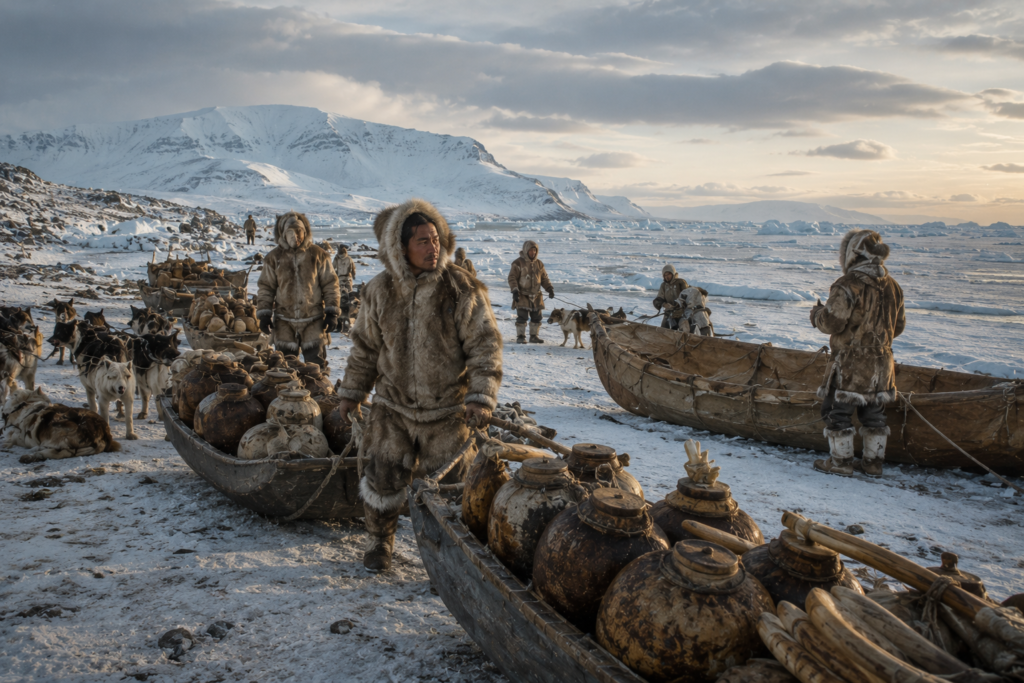
Most people look at the Arctic and see emptiness.
Endless ice. Brutal temperatures. Long winters. Sparse vegetation. A landscape that appears almost hostile to human civilization itself.
At first glance, it seems like one of the last places on Earth where a sophisticated trade network could emerge.
Yet for centuries, Inuit communities built complex economic systems across some of the harshest environments humans have ever inhabited. Long before European explorers arrived, goods, knowledge, tools, and resources traveled across vast Arctic distances through networks connecting communities scattered across Alaska, Canada, Greenland, and parts of the far north.
The most surprising part is what these networks were built around.
Not gold.
Not silver.
Not fertile farmland.
But survival itself.
In a world where food shortages could mean death, where fuel determined whether families survived winter, and where specialized tools made the difference between hunting success and starvation, resources such as whale oil, walrus ivory, sealskins, and hunting technology acquired extraordinary value.
The Arctic demonstrates something many modern people forget.
A resource’s value depends less on what it is and more on where it exists.
In a desert, water becomes wealth.
In a war zone, fuel becomes wealth.
In the Arctic, food and the products derived from it became the foundation of entire economic systems.
The story reveals how humans can build functioning economies almost anywhere, provided they understand their environment well enough.
A World Built Around Survival
Unlike agricultural civilizations, Inuit societies could not depend on farming.
The Arctic climate made large-scale agriculture virtually impossible across most regions where Inuit communities lived. Growing seasons were extremely short, temperatures remained severe, and the landscape offered few opportunities for conventional food production.
This meant survival required specialization.
Communities developed remarkable expertise in hunting marine mammals, fishing, tracking seasonal migrations, navigating ice conditions, and adapting to environmental changes that could rapidly alter living conditions.
Knowledge itself became a valuable asset.
An experienced hunter often possessed information that could literally save lives. Understanding ice thickness, animal migration routes, weather patterns, and hunting techniques allowed communities to survive conditions that outsiders frequently found impossible.
This helps explain why Inuit societies impressed so many explorers who arrived later.
Europeans often viewed Arctic environments as barren wastelands. Inuit communities saw something entirely different: a landscape filled with opportunities for those who knew how to read it.
That knowledge became the foundation of trade.
Why Whale Oil Was So Valuable
To modern readers, whale oil may sound like an obscure historical commodity.
In the Arctic, it was something far more important.
It was energy.
Whale oil served multiple critical functions within Inuit societies. It provided fuel for lamps, generated heat, enabled cooking, and helped illuminate homes during long periods of darkness.
Without reliable energy sources, survival became far more difficult.
A successful whale hunt could support entire communities. The animal provided food, fuel, materials, and trade goods. Few resources offered such comprehensive value.
The importance of whale oil becomes easier to understand if you imagine losing electricity, natural gas, gasoline, heating systems, and cooking fuel simultaneously.
That is roughly the role whale oil played.
Its value extended far beyond simple consumption.
Communities with access to productive hunting grounds often possessed resources other groups wanted. This naturally encouraged exchange between regions possessing different strengths and environmental advantages.
Trade emerged because no community could easily produce everything it needed.
Walrus Ivory: The Arctic’s White Gold
If whale oil provided energy, walrus ivory provided prestige and utility.
Walrus tusks became one of the most important trade commodities in the Arctic world. Durable, workable, and relatively rare, ivory could be transformed into tools, weapons, artwork, ceremonial objects, and trade goods.
Demand extended far beyond Inuit communities.
Over time, Arctic ivory reached Norse settlements, European markets, and broader trade networks connecting the far north to much larger economic systems.
Its value reflected several factors:
- Durability
- Scarcity
- Utility
- Artistic potential
- Prestige
- Ease of transport relative to value
This pattern appears throughout economic history.
Certain commodities become valuable not because they are essential for survival, but because they combine practical usefulness with scarcity. Ivory occupied exactly that position within many Arctic trade relationships.
For some communities, access to walrus hunting grounds represented a significant economic advantage.
The resource effectively functioned as a form of wealth.
Trade Across Vast Distances
One of the biggest misconceptions about Arctic societies is the idea that communities existed in complete isolation.
The reality was far more interconnected.
Trade routes linked settlements across enormous distances. Goods moved gradually through chains of exchanges connecting groups separated by hundreds or even thousands of miles.
Not every trader traveled the entire route.
Instead, goods often moved community by community.
A tool acquired in one region might eventually reach another region through multiple exchanges. Information traveled the same way. New technologies, hunting techniques, raw materials, and cultural practices spread throughout the Arctic through these networks.
The system resembled many premodern trade structures elsewhere in the world.
Despite environmental challenges, Arctic peoples developed surprisingly sophisticated methods for maintaining economic relationships across difficult terrain.
Transportation relied on:
- Dog sleds
- Boats
- Seasonal migration routes
- Coastal travel
- River systems
- Ice corridors
The Arctic was difficult.
It was not disconnected.
The Importance of Food as Wealth
Your answer about food being the most valuable resource is probably the closest mindset to understanding Arctic economics.
In many modern societies, food feels abundant. Most people rarely think about where their next meal will come from. Economic activity revolves around countless other concerns.
In the Arctic, food often remained the central concern.
This fundamentally shaped economic behavior.
A successful hunt created immediate wealth because it produced something everyone needed. Communities frequently shared food resources extensively, partly for cultural reasons and partly because survival often depended on cooperation.
That sharing system sometimes confuses outside observers.
People assume generosity and economics are opposites.
Historically, they often worked together.
Sharing food created obligations, strengthened alliances, improved survival odds, and built social capital. These networks of reciprocity became essential forms of security in environments where unpredictable conditions could threaten anyone.
Food functioned simultaneously as:
| Function | Role |
|---|---|
| Nutrition | Survival |
| Trade Good | Exchange |
| Social Asset | Relationship building |
| Emergency Reserve | Risk management |
| Status Indicator | Successful hunting |
| Community Resource | Collective resilience |
In some respects, food served roles that modern financial assets perform today.
When Europeans Arrived
European contact gradually transformed Arctic trade systems.
Beginning with Norse interactions and accelerating through later exploration, whaling, and commercial expansion, Arctic communities became increasingly connected to global markets.
This created opportunities and risks.
European traders sought:
- Ivory
- Furs
- Whale products
- Arctic resources
- Geographic knowledge
In exchange, Inuit communities gained access to:
- Metal tools
- Firearms
- Manufactured goods
- New technologies
- Imported materials
The exchanges often proved beneficial initially.
However, like many historical encounters between Indigenous societies and expanding commercial powers, the long-term consequences became more complicated.
External markets introduced new incentives. Economic priorities shifted. Traditional systems adapted under pressure from larger global forces.
The Arctic gradually became integrated into expanding international commerce.
Knowledge as an Economic Resource
One aspect of Inuit society often surprises historians.
Knowledge itself functioned almost like capital.
Because Arctic survival depended on environmental expertise, information carried extraordinary practical value. A hunter who understood animal behavior possessed an advantage. A navigator familiar with seasonal ice conditions possessed an advantage. Elders preserving generations of accumulated experience possessed an advantage.
This knowledge could not easily be imported.
It had to be learned.
The pattern feels remarkably modern.
Today, some of the world’s most valuable companies derive much of their worth from knowledge, expertise, software, patents, and intellectual property rather than physical resources.
The Arctic economy demonstrated a similar principle centuries earlier.
Information became valuable because it improved survival.
In some cases, it was more valuable than any material object.
The Myth of Resource Poverty
One reason Arctic trade networks matter historically is that they challenge assumptions about wealth.
Many people assume prosperity requires fertile farmland, large populations, mineral wealth, or favorable climates.
The Inuit experience suggests something different.
Societies can create economic value from almost any environment if they understand local conditions well enough.
The Arctic lacked many resources associated with traditional civilizations.
Yet it possessed:
- Marine mammals
- Fish stocks
- Ivory
- Fur resources
- Transportation routes
- Specialized knowledge
These assets supported functioning economies for centuries.
The lesson extends far beyond the Arctic.
History repeatedly shows that resources become valuable because humans find ways to use them, not because nature labels them important automatically.
Oil was once a nuisance.
Silicon was once ordinary sand.
Data was once meaningless information.
Value emerges through context.
Why Arctic Trade Networks Matter Today
The story of Inuit trade networks remains relevant because it reveals the incredible adaptability of human economic behavior.
Faced with one of the world’s harshest environments, Arctic communities developed systems of exchange, cooperation, specialization, and resource management capable of supporting life where many outsiders believed survival itself was impossible.
The achievement becomes even more impressive when viewed without modern stereotypes.
These were not isolated groups passively enduring nature.
They were active participants in dynamic economic systems that evolved over centuries. They traded, innovated, adapted, and accumulated knowledge in ways that allowed communities to thrive under extraordinary conditions.
Their success came not from conquering the environment but from understanding it.
That distinction may be the most important lesson of all.
Conclusion
The Arctic trade networks built by Inuit communities demonstrate that sophisticated economies can emerge in places that outsiders often dismiss as empty or inhospitable.
Through the exchange of whale oil, walrus ivory, food resources, tools, and specialized knowledge, Arctic peoples created systems that supported survival across vast distances and extreme conditions. These networks connected communities, spread innovation, and transformed scarce resources into forms of wealth suited perfectly to the realities of northern life.
Perhaps the most surprising lesson is how much economic value depended on food and energy.
In environments where survival remained uncertain, resources that sustained life naturally became the foundation of trade. Whale oil powered homes. Hunting success created wealth. Knowledge improved survival. Cooperation reduced risk.
The Arctic economy reminds us that value is never fixed.
It changes with circumstance.
And sometimes, in the coldest places on Earth, the most valuable resource is simply the ability to stay alive.
References
- McGhee, Robert. The Last Imaginary Place: A Human History of the Arctic World. University of Chicago Press, 2005.
- Friesen, T. Max. The Arctic and Its Peoples. Thames & Hudson, 2019.
- Morrison, David. Arctic Hunters and Traders. Canadian Museum of History Publications.
- “Inuit Trade Networks.” The Canadian Encyclopedia. Acesso em: maio de 2026.
- Fitzhugh, William W.; Kaplan, Susan A. Inua: Spirit World of the Bering Sea Eskimo. Smithsonian Institution Press, 1982.
Arctic Inuit trade networks transformed whale oil, ivory, food, and environmental knowledge into valuable economic assets across the frozen North.