
Introduction
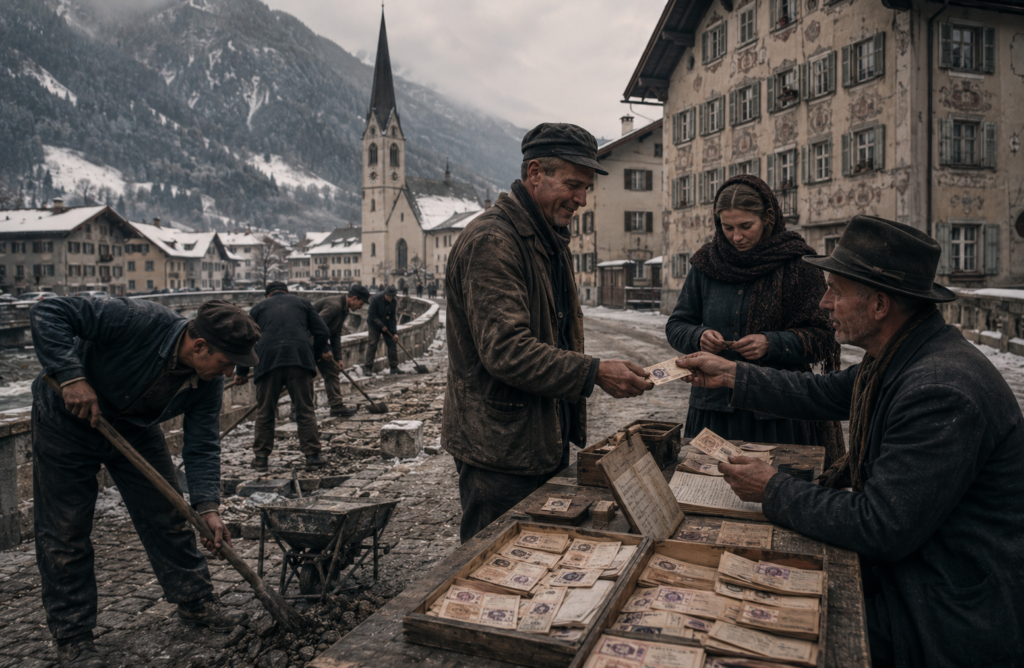
In the middle of the Great Depression, while governments across the world struggled with unemployment, collapsing banks, and frozen economies, a tiny Austrian village tried something that sounded completely insane.
The town printed its own money.
Not fake money hidden in basements or counterfeit bills passed secretly between merchants. This was an organized local currency approved by the town government of Wörgl in 1932. Even stranger, the money was intentionally designed to lose value over time if people refused to spend it.
At first, the entire idea sounds ridiculous. Why would anyone willingly hold money that slowly became less valuable every month?
Then you realize modern inflation already works similarly.
Most people understand instinctively that leaving cash idle for years slowly reduces its purchasing power. The difference is that Wörgl made the process visible and intentional. Instead of quietly allowing inflation to erode value over time, the town openly created a currency that encouraged constant circulation.
And somehow, against all expectations, it worked.
Roads were repaired. Public works projects restarted. Businesses recovered. Unemployment dropped. While much of Europe remained trapped in economic paralysis, this small Alpine village suddenly became one of the most talked-about economic experiments in the world.
That success also created a problem.
The experiment frightened central bankers because it suggested ordinary communities might not need to depend entirely on national financial systems to revive local economies.
Austria During the Great Depression
To understand why Wörgl became so desperate, you need to understand how catastrophic the early 1930s were for Austria.
The Great Depression devastated Europe after the global financial collapse that followed the 1929 Wall Street crash. Austria suffered particularly severe economic damage because its banking system was already fragile after World War I and the collapse of the Austro-Hungarian Empire.
By the early 1930s, unemployment soared across the country. Businesses failed, banks collapsed, and local governments struggled to fund even basic infrastructure projects.
Wörgl itself was a small railway town in the Tyrol region with roughly 4,000 residents. Like countless towns during the Depression, it faced growing unemployment, shrinking tax revenue, and stalled economic activity.
People still needed goods and services. Workers still wanted jobs. Businesses still existed.
But money stopped moving.
That detail matters because economic crises often become psychological as much as financial. During periods of fear, people hoard money rather than spending it. Businesses delay investments. Consumers postpone purchases. Entire economies can freeze even when productive capacity still exists.
Anyone familiar with periods of high inflation or financial instability understands this behavior immediately. Before Brazil’s Plano Real in 1994, many Brazilians rushed to spend money quickly because waiting too long meant losing purchasing power. Urgency changes economic behavior.
Wörgl’s leaders understood something similar. The problem was not simply a lack of labor or resources. The deeper problem was the paralysis caused by stagnant money.
The Man Behind the Experiment
The driving force behind the Wörgl experiment was Mayor Michael Unterguggenberger.
Unterguggenberger was not a famous economist or international banker. He was a local politician trying to solve practical problems inside a struggling town. Influenced partly by the economic theories of German-Argentine economist Silvio Gesell, he believed economies function best when money circulates continuously instead of being hoarded.
Gesell argued that money had an unfair advantage over goods and labor because people could simply hold cash indefinitely while waiting for better opportunities. During crises, this tendency worsened economic slowdowns because circulation collapsed.
His proposed solution was radical.
Money should lose value gradually if people refused to use it.
That concept became known as “demurrage,” essentially a carrying cost attached to holding currency. Instead of rewarding hoarding, the system encouraged spending, investment, and circulation.
In July 1932, Wörgl introduced its own local currency called “Certified Compensation Bills.” Residents quickly nicknamed it “stamp scrip.”
The system worked in an unusual way. Every month, holders had to purchase a small stamp equal to 1% of the bill’s value and attach it to keep the currency valid. If someone failed to add the stamp, the bill lost validity.
This created enormous pressure to spend the money quickly rather than hoarding it.
How the Wörgl Currency Actually Worked
The local currency was backed by deposits of Austrian schillings held by the town. Technically, residents could exchange the local notes for official currency if needed. But the key difference was how rapidly the Wörgl money circulated.
Because holding the notes carried a monthly cost, people spent them as quickly as possible.
Workers paid local merchants.
Merchants paid suppliers.
Suppliers paid taxes.
Taxes funded public projects.
The same money moved through the local economy repeatedly instead of sitting idle.
| Characteristic | Wörgl Currency System |
|---|---|
| Introduced | July 1932 |
| Location | Wörgl, Austria |
| Population | Around 4,000 residents |
| Currency Type | Local stamp scrip |
| Economic Theory | Demurrage / circulating money |
| Monthly Cost | 1% stamp fee to maintain validity |
| Goal | Increase spending and economic activity |
| Backed By | Austrian schilling reserves |
| Main Effect | Faster local money circulation |
The results became difficult to ignore.
The town used the currency to finance infrastructure projects including roads, bridges, street lighting, and sewage improvements. Unemployed workers found jobs again. Tax collection improved because residents preferred paying taxes early rather than losing value holding the notes.
Observers from across Europe visited Wörgl to study the experiment.
At the height of the project, journalists called the town “the miracle of Wörgl.”
Why the Currency Seemed to Work
The success of Wörgl came largely from psychology and circulation speed.
During economic crises, fear causes people to stop spending. Everyone waits for better conditions, which only deepens stagnation. Businesses suffer from lower demand, workers lose jobs, and local governments collect less tax revenue.
The Wörgl currency attacked that paralysis directly.
Because the notes lost value slowly over time, residents had a strong incentive to keep money moving constantly through the local economy.
That created several effects simultaneously:
- Businesses saw faster customer activity
- Tax payments accelerated
- Public projects restarted
- Unemployed workers returned to jobs
- Confidence inside the town improved
- Local trade intensified
This is why the experiment still fascinates economists today.
The system revealed how strongly human behavior shapes economies. People do not respond only to mathematical models or abstract policy decisions. They respond emotionally to incentives, urgency, and collective expectations.
Anyone who experienced periods of inflation understands this instinctively. When people believe money will lose value, they spend faster. Sometimes that behavior becomes destructive, but under certain conditions it can also revive frozen economic activity.
The Wörgl experiment essentially weaponized urgency in a controlled local environment.
Why Central Bankers Became Nervous
The success of Wörgl created a dangerous political question.
What happens if local communities discover they can partially bypass national monetary systems?
The Austrian National Bank became increasingly uncomfortable watching a small town generate international attention using its own currency model. Other Austrian towns began showing interest in creating similar systems.
To central authorities, this threatened more than monetary policy.
It threatened control.
Governments and central banks generally want strong economies because economic stability supports political stability. But maintaining centralized authority over money issuance is also one of the foundations of modern state power.
The Wörgl experiment suggested local governments might create parallel systems capable of influencing economic activity independently.
That possibility alarmed national officials.
In 1933, after legal challenges, Austria’s central bank forced Wörgl to stop issuing the currency. The Austrian Supreme Court eventually ruled that only the national bank had legal authority to issue money.
Once the experiment ended, unemployment in Wörgl reportedly began rising again.
The shutdown transformed the town into a symbol for critics of centralized monetary systems.
Wörgl vs. Modern Inflation
One reason the Wörgl experiment still feels surprisingly modern is because people already live with currencies that slowly lose value over time.
Inflation creates a softer version of the same pressure.
Most people understand that leaving large amounts of cash idle for years usually reduces purchasing power. This encourages investment, consumption, and economic activity instead of indefinite hoarding.
The difference is that inflation usually operates indirectly and unevenly. Wörgl made the process visible and explicit.
| Wörgl Currency | Modern Inflation |
|---|---|
| Value decreased visibly every month | Purchasing power erodes gradually over time |
| Spending encouraged intentionally | Spending encouraged indirectly |
| Local circulation was the goal | National economic growth is the goal |
| Small community experiment | Nationwide monetary policy |
| Demurrage fee was obvious | Inflation often feels less visible initially |
| Currency moved rapidly between residents | Modern economies rely on consumer circulation too |
The comparison also reveals why monetary systems depend heavily on psychology.
People behave differently depending on whether they expect money to gain value, maintain value, or lose value. Economic activity is not just about production. It is also about expectations.
That is one reason central banks spend enormous effort managing confidence and public perception.
The Global Fascination With Wörgl
Despite lasting only about a year, the Wörgl experiment attracted worldwide attention.
Economists, journalists, politicians, and reformers traveled to Austria to observe what was happening inside the town. At a time when many governments seemed incapable of reducing unemployment, Wörgl appeared to offer an alternative model.
The experiment also influenced later discussions about complementary currencies and local exchange systems.
Throughout the twentieth and twenty-first centuries, various communities experimented with local currencies designed to strengthen regional economies, encourage local spending, or increase economic resilience during crises.
Most remained small-scale.
None became dominant alternatives to national currencies.
Still, the fascination never disappeared because Wörgl touched a deeper question that modern societies continue debating:
What exactly gives money value?
Is it government authority alone?
Public trust?
Scarcity?
Circulation?
Collective belief?
The Wörgl experiment suggested that the speed and movement of money might matter just as much as the quantity itself.
What Wörgl Reveals About Power and Economics
The story of Wörgl is not really about one tiny Austrian village printing paper notes during the Great Depression.
It is about the relationship between money, trust, incentives, and power.
Modern economies often assume centralized monetary systems are the only serious way to organize large-scale financial life. But Wörgl demonstrated that communities can sometimes generate economic momentum simply by changing how people behave around money.
That possibility naturally creates tension with centralized institutions.
Governments and central banks generally pursue strong economies because economic growth supports tax revenue, political legitimacy, and social stability. But they also seek to maintain authority over monetary systems because control over money is deeply connected to state power.
The Wörgl experiment briefly exposed what happens when local communities test those boundaries.
It also revealed how emotional economics can become.
Fear freezes spending.
Confidence accelerates it.
Urgency changes behavior.
People are not machines making perfectly rational decisions. Entire economies can shift depending on collective expectations and psychological incentives.
That insight remains just as relevant today as it was during the Great Depression.
Conclusion
The village of Wörgl became famous because it tried something most governments would never dare attempt openly: creating money designed to punish inactivity.
For a brief moment during one of the worst economic crises in modern history, the experiment appeared to work. Unemployment fell, infrastructure improved, and local economic activity accelerated while much of the world remained trapped in depression.
That success also exposed why monetary systems are never only about economics.
They are about control.
The Wörgl experiment frightened central bankers not simply because a small town printed local currency, but because it suggested ordinary communities might influence economic behavior without waiting for national institutions to act first.
Almost a century later, the story still feels strangely modern. People continue arguing about inflation, central banking, economic incentives, and whether money should primarily store value or keep moving constantly through society.
Wörgl never fully answered those questions.
But for one short period in the 1930s, a tiny Austrian village forced the financial world to confront them directly.
Wörgl’s local currency experiment during the Great Depression revived a struggling Austrian town and alarmed central bankers across Europe.