
Introduction
When people imagine powerful economic figures in pre-colonial history, they usually picture kings, merchants, bankers, generals, or imperial officials.
Rarely do they imagine thousands of women controlling the commercial heartbeat of an entire kingdom.
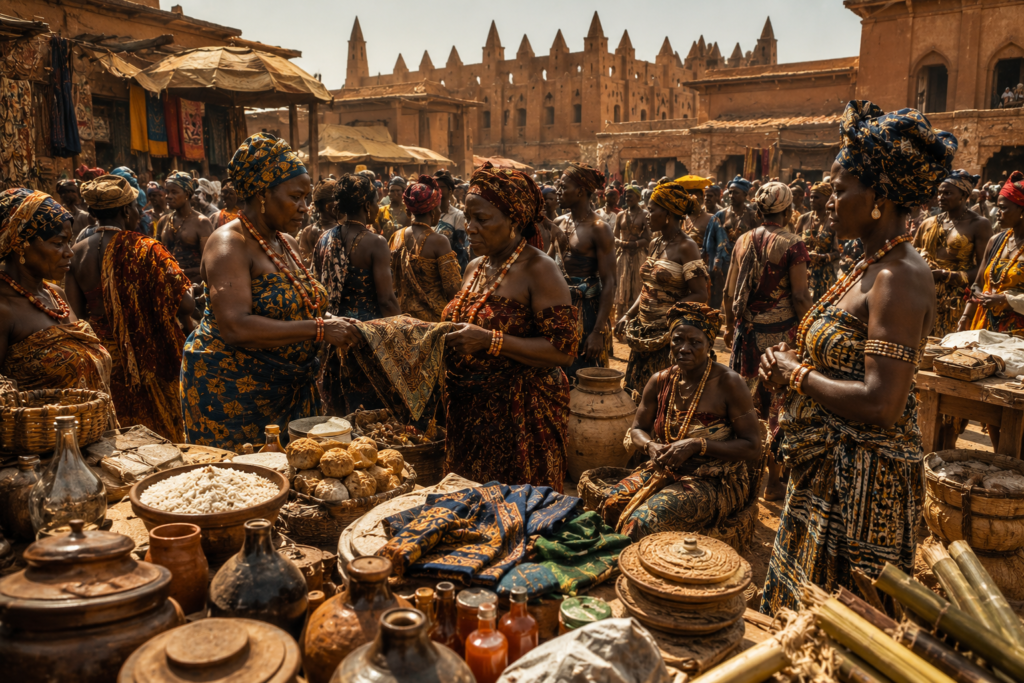
But in the Kingdom of Dahomey, located in present-day Benin in West Africa, women dominated large sections of market life so completely that European visitors often described the system with surprise bordering on disbelief. Long before modern conversations about financial independence or women in business, Dahomey developed a commercial culture where female traders exercised enormous influence over prices, supply chains, regional commerce, and everyday economic survival.
The strange part is how little most people know about it.
Global economic history often focuses heavily on Europe, large empires, industrialization, and male political leadership. Entire systems where women played central economic roles frequently became footnotes or disappeared from mainstream historical narratives altogether.
That absence says a lot.
The women running Dahomey’s markets were not symbolic participants standing quietly in the background. They were operators, negotiators, organizers, distributors, and power brokers inside one of West Africa’s most commercially active regions.
And in many ways, they understood something fundamental about economic power:
The people controlling daily circulation often shape society more deeply than the people sitting formally at the top.
What Was the Kingdom of Dahomey?
The Kingdom of Dahomey emerged during the seventeenth century in what is now southern Benin.
Founded around 1600, Dahomey gradually expanded into one of the most organized and militarily powerful states in West Africa. The kingdom became known internationally for several reasons, including centralized royal authority, highly structured political systems, extensive regional trade networks, and the famous all-female military regiments Europeans later nicknamed the “Dahomey Amazons.”
But military power represented only part of the kingdom’s strength.
Commerce fueled the system.
Dahomey occupied an economically strategic position connected to inland African trade routes and Atlantic coastal exchange networks. Goods constantly moved through the kingdom, including:
- Palm oil
- Textiles
- Tobacco
- Salt
- Agricultural products
- Metal goods
- Slaves during the Atlantic slave trade period
- Imported European products
Markets became essential infrastructure supporting both everyday life and state revenue.
This is where women entered the center of economic activity.
Unlike many European societies during the same periods, Dahomey developed commercial systems where women played dominant roles in local and regional trade. Female merchants became deeply embedded inside market organization itself.
That did not mean Dahomey was some perfectly egalitarian society. It absolutely was not.
The kingdom remained hierarchical, militarized, and deeply connected to systems of royal authority. But economically, women occupied positions of influence far larger than many outsiders expected.
How Dahomey’s Markets Actually Worked
Markets in Dahomey operated as highly organized economic hubs rather than simple open-air trading spaces.
Different goods circulated through different networks, often managed by specialized groups of traders with established relationships, negotiation systems, and supply connections. Women frequently controlled retail distribution, food commerce, local exchange systems, and significant sections of regional trade activity.
The structure created something extremely important:
Economic visibility.
Women participating heavily in daily commerce became unavoidable actors within the functioning of society itself. They handled transactions, negotiated prices, managed inventories, maintained supplier relationships, and influenced local economic stability directly.
Some female traders accumulated substantial wealth and influence over time.
European travelers visiting West Africa during the eighteenth and nineteenth centuries often commented on the strong commercial presence of women in regional marketplaces. In some accounts, observers appeared genuinely surprised by how economically active and assertive many traders were compared to European expectations surrounding gender roles.
| Characteristic | Dahomey Market System |
|---|---|
| Main Region | Present-day Benin |
| Peak Period | 17th–19th centuries |
| Economic Structure | Regional trade and market networks |
| Female Role | Dominant in many commercial sectors |
| Main Goods | Palm oil, textiles, food, salt, tobacco |
| Political Context | Centralized monarchy |
| Market Importance | Economic and social infrastructure |
| Source of Influence | Control over circulation and trade |
The key detail here is circulation.
Economic power often belongs not only to people producing wealth, but also to people controlling movement, distribution, and access.
That principle appears constantly throughout history.
Why Women Became So Economically Influential
Historians still debate exactly why women occupied such strong commercial roles across parts of West Africa compared to many contemporary European societies.
The explanation likely involves multiple overlapping factors rather than one single cause.
In many West African economic systems, gender divisions of labor evolved differently from European patterns. Women frequently participated heavily in agriculture, food processing, local trade, and market exchange long before colonial influence reshaped regional economies.
Over time, that participation became institutionalized.
Markets developed around social expectations already recognizing women as central commercial actors. This allowed female traders to build networks, reputations, expertise, and financial independence across generations.
Several conditions strengthened their influence:
- Control over food distribution
- Strong local trading traditions
- Multi-generational commercial knowledge
- Dense regional market systems
- Daily interaction with consumers
- Social acceptance of female trade activity
The result was subtle but powerful.
Women became economically indispensable even within broader patriarchal political systems.
That distinction matters because economic influence does not always align neatly with formal political titles. Sometimes the individuals controlling everyday transactions, supply flows, and local exchange networks possess enormous practical power without necessarily holding the highest visible office.
Modern societies still experience versions of this dynamic constantly.
Financial systems often depend heavily on operational actors working beneath the most publicly visible leadership structures. The people quietly controlling circulation sometimes shape outcomes more directly than those occupying ceremonial authority.
The Connection Between Markets and Political Power
The Kingdom of Dahomey understood something many states eventually learn:
Markets are political.
Economic stability affects taxation, food access, public order, and social legitimacy. Rulers therefore paid close attention to commercial systems because functioning markets strengthened the kingdom itself.
Female traders became important partly because they connected state authority with daily economic life.
Royal administrations sometimes regulated market systems, collected taxes, or supervised trade activities. At the same time, merchants maintained influence because rulers depended on functioning commercial networks to support urban centers and regional exchange.
This created a complicated relationship between monarchy and commerce.
The market women were not isolated entrepreneurs operating independently from the kingdom. They functioned inside larger political and economic systems while still maintaining meaningful influence within those structures.
That relationship becomes especially important during periods of crisis.
When food shortages, trade disruptions, or political instability emerged, the people controlling local distribution networks suddenly became extremely important. Economic organization often determines whether societies remain stable or collapse under pressure.
Dahomey’s market structure therefore represented more than simple trade.
It represented social infrastructure.
European Colonialism and the Distortion of the Narrative
One reason many people know so little about Dahomey’s market women involves the way colonial narratives shaped historical memory.
European colonial powers frequently interpreted African societies through deeply distorted frameworks. Colonial writers often emphasized warfare, exoticism, or political domination while minimizing sophisticated local economic systems already operating before European intervention.
Women’s economic roles became especially vulnerable to erasure.
Colonial societies themselves often carried rigid assumptions about gender and commerce. As a result, European observers sometimes misunderstood, dismissed, or underreported the significance of female traders in West African economies.
This reflected broader structural biases.
Economic history has long centered heavily around male political leadership, formal institutions, industrial capitalism, and European commercial expansion. Informal systems, local markets, and female economic influence often received far less attention despite their enormous practical importance.
That imbalance still shapes public understanding today.
Many people can easily name European banking dynasties or industrial magnates. Far fewer know about the women organizing large sections of West African commercial life centuries earlier.
The omission is not accidental.
Historical memory often reflects power structures deciding which stories deserve preservation.
Dahomey’s Markets vs. European Economic Systems
Comparing Dahomey’s commercial culture with many European societies during the same periods reveals striking differences.
| Dahomey Market System | Many Contemporary European Systems |
|---|---|
| Women heavily involved in trade | Men dominated formal commerce |
| Female merchants highly visible | Female economic roles often restricted |
| Markets central to daily social life | Commerce more institutionally controlled |
| Regional trade networks decentralized | Stronger guild and institutional systems |
| Informal influence mattered greatly | Formal legal authority emphasized |
The comparison should not be romanticized too much.
Dahomey was not a modern feminist society transported backward through time. Social hierarchies, royal authority, and gender limitations absolutely still existed.
But economically, women possessed practical influence difficult to ignore.
That reality complicates simplistic assumptions about historical progress always moving in straight lines from “backward” societies toward “advanced” ones.
Different civilizations organized labor, gender, and commerce in very different ways.
Sometimes societies considered “less developed” by colonial powers actually allowed forms of economic participation more flexible than those inside supposedly more advanced European systems.
What the Market Women of Dahomey Reveal About Power
The women running Dahomey’s markets reveal something many economic systems try to hide.
Power often lives inside ordinary circulation.
People frequently imagine influence flowing only from kings, presidents, generals, or wealthy elites. But societies also depend constantly on networks of distribution, negotiation, logistics, and daily exchange operated by less visible actors.
The market women occupied that position.
They connected producers to consumers, villages to cities, and households to broader commercial systems. Their influence emerged not primarily through military force or formal political office, but through economic indispensability.
That kind of power can become extremely durable.
The story also reveals how structural sexism shapes historical memory itself. Women’s labor frequently sustains economies while receiving far less recognition inside official narratives. Entire commercial systems can function partly through female organization while history books still focus overwhelmingly on male rulers and political events.
Dahomey’s market women survived history mostly in fragments despite their enormous economic importance.
That silence says as much about the historians writing the records as it does about the women themselves.
Conclusion
The women running Dahomey’s markets were far more than background figures inside West African history.
They operated one of the most active commercial systems in the region, controlling circulation networks, managing trade relationships, and shaping daily economic life inside a powerful kingdom centuries before modern conversations about women in business became common.
Their influence reveals how economic power often works quietly.
The people moving goods, organizing supply, and maintaining everyday exchange systems can shape societies just as deeply as armies or political leaders. Formal authority matters, but daily circulation keeps civilizations alive.
The story also exposes how historical memory repeatedly minimizes female economic influence through colonial bias and structural sexism. Entire systems where women exercised substantial commercial power often disappeared beneath narratives centered around male rulers, wars, and imperial expansion.
Dahomey’s market women remind us that history’s financial powerhouses do not always look the way modern people expect.
Sometimes they are not sitting on thrones or inside banks.
Sometimes they are standing in crowded marketplaces quietly controlling the economic pulse of an entire society.
The women running Dahomey’s markets built one of West Africa’s most influential commercial systems, revealing hidden female economic power in pre-colonial Africa.