
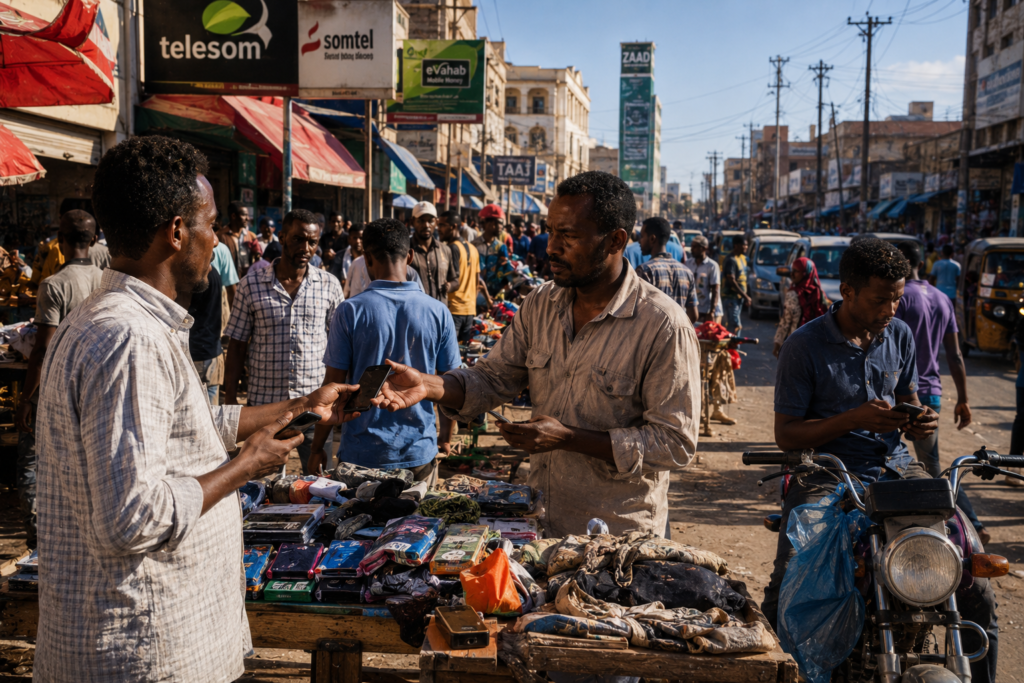
For most people, phone credits feel temporary and forgettable.
You recharge your balance, send messages, use mobile data, maybe transfer a few dollars through an app, and move on with your day without thinking much about it. But in Somalia, mobile phone credits evolved into something far more important than simple telecommunications.
At certain points, they effectively became a parallel monetary system.
People used phone balances to pay debts, exchange value, send money between cities, purchase goods, and operate businesses in an environment where formal banking infrastructure remained weak, fragmented, or inaccessible for large parts of the population.
The strange part is that the system emerged almost naturally.
Nobody sat down and officially declared mobile minutes a national currency. The economy adapted pragmatically because the population needed fast, trusted, and portable ways to move value through unstable conditions. Over time, telecom systems started functioning partly like banks, partly like payment processors, and partly like informal monetary infrastructure.
Modern societies are actually closer to this reality than many people realize.
Most people no longer visit banks physically unless absolutely necessary. Smartphones already function like extensions of personal financial identity. Losing battery, internet access, or mobile service can suddenly make everyday life feel strangely impossible because so many essential systems now depend on digital access.
Somalia simply arrived at this future earlier and under more extreme circumstances.
The result became one of the world’s most fascinating unofficial monetary experiments.
Why Somalia’s Economy Became So Unusual
To understand Somalia’s mobile economy, it helps to understand the country’s political and financial history first.
After the collapse of Somalia’s central government in 1991, the country entered a long period of political fragmentation, civil conflict, and institutional instability. Traditional state infrastructure weakened dramatically across many regions, including formal banking systems.
Under ordinary circumstances, most economies depend heavily on centralized institutions:
- National banks
- Stable currency regulation
- Government oversight
- Financial infrastructure
- Legal enforcement systems
Somalia lost large portions of that structure for extended periods.
But economic activity did not disappear.
People still needed to trade, send money to relatives, buy food, pay workers, and move resources between communities. Markets adapted because human societies always adapt economically even under unstable political conditions.
Telecommunications companies eventually became some of the most functional and trusted institutions operating inside the country.
That detail changed everything.
How Telecom Companies Became Financial Institutions
During the late 1990s and early 2000s, mobile phone usage expanded rapidly across Somalia despite broader state instability.
Telecom companies filled gaps left behind by weak public infrastructure. In some regions, mobile services actually developed faster and more efficiently than outsiders expected precisely because private operators faced less centralized bureaucracy than in many neighboring countries.
As mobile networks expanded, companies introduced prepaid credit systems.
At first, these systems simply allowed users to buy phone minutes and communication services. But gradually, something more interesting happened: people began treating mobile balances as transferable stores of value.
Instead of exchanging physical cash directly, individuals could transfer prepaid credits between phones.
This solved several problems simultaneously:
- Safer long-distance transfers
- Faster transactions
- Reduced need for physical cash
- Greater portability
- Easier remote payments
- Lower theft risk
The system evolved organically because it was useful.
That is one of the most important lessons in monetary history. Many alternative currencies or exchange systems emerge not from ideology, but from practicality. People adopt whatever method moves value efficiently under the conditions surrounding them.
In Somalia, phone credits started functioning almost like digital cash before many wealthy countries fully normalized mobile payments themselves.
The Rise of Mobile Money in Somalia
Over time, telecom systems evolved beyond prepaid minutes into sophisticated mobile money ecosystems.
Companies such as Hormuud Telecom launched platforms like EVC Plus, allowing users to send money, pay bills, buy goods, and transfer funds entirely through mobile phones. In practice, these systems became deeply embedded inside daily economic life across large parts of Somalia.
The transformation happened surprisingly fast.
Merchants accepted mobile payments.
Families transferred money instantly.
Businesses operated digitally.
Street vendors processed transactions electronically.
For many Somalis, mobile balances became more practical than relying heavily on physical cash.
This happened partly because traditional banking infrastructure remained limited, but also because mobile systems solved real everyday problems more effectively than older alternatives.
| Characteristic | Somalia’s Mobile Economy |
|---|---|
| Main Technology | Mobile phone credits and transfers |
| Major Expansion | 2000s onward |
| Key Companies | Hormuud Telecom and others |
| Main Function | Payments and money transfers |
| Traditional Banking Access | Limited in many regions |
| Popular Mobile System | EVC Plus |
| Economic Role | Shadow financial infrastructure |
| Main Advantage | Speed and accessibility |
The system became so normalized that many everyday transactions started happening almost entirely through phones rather than cash.
That shift feels extremely modern now, but Somalia reached this reality under conditions most outsiders would never associate with technological innovation.
Why People Trusted Phone Credits
Trust determines whether any monetary system survives.
This includes official currencies, gold, digital banking, cryptocurrencies, or mobile balances. People use systems they believe others will continue accepting tomorrow.
In Somalia, telecom-based value systems gained trust partly because telecom companies themselves became relatively stable institutions compared to broader political uncertainty.
That is fascinating psychologically.
In many countries, people instinctively trust governments and central banks more than private telecom firms. Somalia’s circumstances partially inverted that relationship. Mobile companies often delivered more reliable services than fragmented public institutions, making telecom platforms feel dependable for everyday economic life.
Several factors increased adoption:
- Fast transfers
- Widespread phone access
- Low transaction friction
- Relative institutional reliability
- Ease of use
- Safety compared to carrying cash
- Ability to function across fragmented regions
The comparison with modern societies becomes increasingly obvious here.
Today smartphones already function as gateways to banking, communication, identity verification, shopping, transportation, and financial management simultaneously. Many people rarely interact physically with banks anymore because mobile access replaced large parts of traditional infrastructure.
Somalia simply compressed this evolution dramatically faster.
When Phone Credits Start Behaving Like Currency
The moment something becomes widely accepted for exchange, it starts behaving economically like money whether governments formally classify it that way or not.
Somalia’s mobile balances gradually acquired several classic monetary characteristics:
- Store of value
- Medium of exchange
- Transferability
- Broad social acceptance
- Transaction efficiency
That effectively turned telecom systems into shadow financial networks operating alongside or sometimes beyond traditional state monetary structures.
This phenomenon appears repeatedly throughout history.
Whenever official systems weaken, alternative forms of value exchange emerge naturally:
- Cigarettes in prisons or wartime camps
- Precious metals during inflation crises
- Shell currencies in trade societies
- Phone credits in digital economies
- Cryptocurrency in certain unstable regions
Humans consistently prioritize functionality over official definitions.
If something reliably moves value, people start treating it like money.
The Somali case became especially remarkable because the system scaled nationally across large populations rather than remaining isolated to small communities.
Somalia vs. Traditional Banking Systems
The Somali mobile economy challenged several assumptions about financial development.
For decades, many economists assumed advanced banking systems required strong centralized state institutions first. Somalia complicated that narrative by demonstrating that decentralized mobile infrastructure could partially substitute for traditional banking functions under certain conditions.
| Traditional Banking | Somalia’s Mobile Economy |
|---|---|
| Physical bank branches | Mobile networks |
| Centralized infrastructure | Telecom-based systems |
| Formal accounts | Phone-linked balances |
| Government regulation dominant | Private operators highly influential |
| Cash-heavy transactions | Digital mobile transfers |
| Slower accessibility expansion | Rapid mobile penetration |
This does not mean Somalia solved every financial problem perfectly.
The country still faced enormous economic and political challenges, including inequality, instability, regulatory limitations, and infrastructure difficulties. But the mobile payment ecosystem revealed how quickly populations adapt technologically once systems provide practical utility.
In some ways, Somalia became a preview of broader global financial trends.
Many wealthy countries are now gradually moving toward increasingly cashless economies where smartphones function as primary financial interfaces.
The Risks of a Fully Digital Monetary World
Despite the efficiency advantages, Somalia’s mobile economy also reveals vulnerabilities associated with digital dependence.
Modern people already experience glimpses of this constantly.
A dead battery can suddenly block access to banking, transportation, communication, identification, navigation, and payments all at once. Internet outages or technical failures can disrupt basic economic activity surprisingly quickly.
As societies digitize further, dependence intensifies.
The Somali experience exposed both sides of this transformation:
Advantages
- Convenience
- Accessibility
- Fast transfers
- Reduced physical cash handling
- Broader financial inclusion
Risks
- Dependence on telecom infrastructure
- Vulnerability to outages
- Concentrated private-sector influence
- Reduced physical backup systems
- Cybersecurity concerns
Still, many people increasingly view digital monetary systems as the natural direction of human economic evolution.
Physical cash usage already declines across many developed economies. Younger generations often interact with money primarily through screens rather than tangible currency itself.
Somalia reached that transition through necessity rather than luxury.
What Somalia’s Mobile Economy Reveals About Human Nature
The Somali mobile minute economy reveals how adaptable humans become when institutions weaken or technology opens new possibilities.
People rarely care deeply about what money officially is.
They care whether it works.
If value can move safely, efficiently, and reliably through a system, populations start trusting it regardless of whether the system originated from governments, banks, telecom firms, or entirely informal networks.
That flexibility has existed throughout history.
Societies repeatedly reinvent exchange systems whenever existing structures fail, weaken, or become inconvenient. Humans are remarkably pragmatic economically. Ideology matters less than functionality most of the time.
The story also reveals how quickly technology reshapes human behavior once convenience becomes overwhelming.
Most modern people already treat phones almost like external memory systems for identity, communication, navigation, and finance. Losing access even temporarily creates immediate anxiety because digital infrastructure became psychologically integrated into daily life itself.
Somalia simply demonstrated what happens when that integration extends directly into monetary survival.
Conclusion
Somalia’s mobile minute economy became one of the world’s most fascinating examples of alternative financial evolution.
In a country where formal banking infrastructure struggled under political fragmentation and instability, telecom systems gradually transformed into shadow monetary networks capable of moving enormous amounts of value digitally through ordinary mobile phones.
Phone credits stopped behaving like simple communication products.
They started functioning economically like money.
The system emerged not because economists designed a perfect experiment, but because people needed practical solutions for everyday survival and commerce. Over time, convenience, trust, and accessibility turned mobile balances into one of the most important financial tools in the country.
Today, much of the world is slowly moving in a similar direction.
Physical cash becomes less central.
Phones become financial identities.
Digital systems increasingly replace traditional banking interactions.
Somalia simply reached this future earlier than most people expected, revealing both the extraordinary flexibility and hidden fragility inside modern monetary systems.
The Somali mobile minute economy showed how phone credits evolved into a trusted shadow currency in a country with limited traditional banking infrastructure.
References
- “Mobile Money in Somalia.” GSMA Mobile for Development. Acesso em: maio de 2026. Disponível em: https://www.gsma.com
- “The Money Revolution in Somalia.” BBC News. Acesso em: maio de 2026. Disponível em: https://www.bbc.com
- “EVC Plus and Mobile Payments in Somalia.” Hormuud Telecom. Acesso em: maio de 2026. Disponível em: https://www.hormuud.com
- “Money, Technology and Trust in Somalia.” World Bank Group. Acesso em: maio de 2026. Disponível em: https://www.worldbank.org
Somalia’s mobile phone credit economy transformed telecom balances into a shadow currency long before cashless societies became global trends.