
When people think about a gold rush, they usually imagine miners.
Prospectors crossing mountains.
Men digging rivers.
Fortunes being discovered overnight.
History tells a different story.
Many of the largest fortunes created during gold rushes did not come from finding gold. They came from selling tools, transportation, lodging, banking services, food, and infrastructure to the people chasing gold.
Levi Strauss became famous selling durable clothing.
Wells Fargo grew by transporting money and valuables.
Countless merchants, builders, and service providers prospered without extracting a single ounce of gold.
The pattern appears repeatedly throughout economic history.
When a new frontier opens, attention focuses on the treasure.
Money often flows toward the infrastructure.
Today, artificial intelligence may be creating a remarkably similar dynamic.
Most headlines focus on AI models, chatbots, and software companies. Investors debate which AI platform will dominate. Startups race to develop new applications.
Meanwhile, a different competition is unfolding in the background.
Cities are competing for data centers.
Utility companies are upgrading infrastructure.
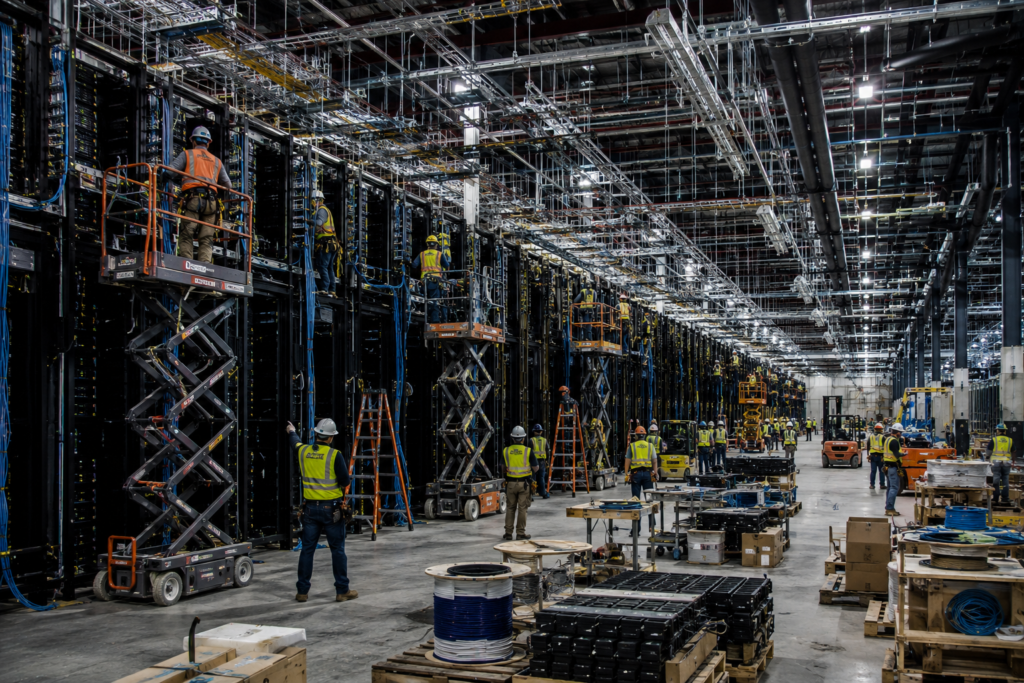
Construction firms are building massive facilities.
Energy providers are securing long-term contracts.
The modern equivalent of the gold rush may not be happening inside software.
It may be happening inside the infrastructure required to support it.
The New Prospectors
During the California Gold Rush, thousands of people moved toward a region that promised opportunity.
Not everyone found gold.
Most did not.
But the belief that wealth existed attracted enormous amounts of capital, labor, and infrastructure investment.
Artificial intelligence is producing a similar effect.
Today, companies are pouring hundreds of billions of dollars into AI development. Governments view the technology as strategically important. Investors see enormous potential. Businesses fear being left behind.
The excitement is real.
But just as miners needed picks, shovels, roads, railroads, and banks, AI companies need infrastructure.
A surprising amount of it.
And that infrastructure is becoming an industry of its own.
Why Everyone Suddenly Wants Data Centers
At first glance, data centers do not seem exciting.
They are essentially buildings filled with computers.
No charismatic founders.
No flashy consumer products.
No viral announcements.
Yet these facilities have become some of the most valuable pieces of infrastructure in the modern economy.
Every AI model requires computing power.
Computing power requires servers.
Servers require buildings.
Buildings require electricity, cooling systems, networking equipment, land, permits, and construction.
The chain continues outward.
The more AI grows, the more infrastructure becomes necessary.
This transforms data centers from a niche industry into a strategic asset.
A decade ago, many local governments barely thought about them.
Today, cities actively compete to attract them.
The Competition Nobody Saw Coming
Your answer focused on competition for installations.
That may be the most fascinating part of the story.
Traditionally, cities competed for:
- Factories
- Corporate headquarters
- Ports
- Manufacturing facilities
- Distribution centers
Increasingly, they are competing for data centers.
Why?
Because data centers bring investment.
They create construction jobs.
They generate tax revenue.
They encourage supporting industries.
They increase local economic activity.
Some regions now market themselves specifically as attractive locations for AI infrastructure.
The competition resembles earlier economic booms.
Communities understand that attracting the supporting infrastructure of a growing industry can create long-term benefits.
Even if they never produce the final product themselves.
The Hidden Layer Beneath AI
Most people think about AI as software.
The reality is much more physical.
Behind every chatbot response sits a chain of infrastructure that includes:
- Data centers
- Power stations
- Transmission lines
- Cooling systems
- Fiber networks
- Construction projects
- Semiconductor supply chains
This infrastructure rarely receives attention because users never see it.
People see the interface.
They do not see the machinery.
Yet history repeatedly shows that invisible infrastructure often determines the winners of economic revolutions.
Railroads shaped industrialization.
Electric grids shaped manufacturing.
Fiber-optic networks shaped the internet.
Data centers may play a similar role in the AI era.
The Gold Rush Lesson
One reason your answer about the first layer making the most money is interesting is that history partially agrees.
Gold rushes often created fortunes for miners.
But mining was risky.
Infrastructure businesses frequently enjoyed more predictable economics.
A merchant selling equipment did not need to discover gold.
A hotel owner did not need to strike a rich vein.
A transportation company did not depend on luck.
They benefited from the overall boom.
The same logic may apply to AI.
Nobody knows which AI company will dominate twenty years from now.
The competition remains intense.
Infrastructure providers occupy a different position.
They benefit from growth across the entire ecosystem.
That distinction matters.
Why Energy Keeps Appearing
One pattern emerges repeatedly in modern AI discussions.
Everything eventually leads back to electricity.
Data centers require enormous power supplies.
As facilities become larger, demand increases further.
This creates opportunities for:
- Utilities
- Electrical equipment manufacturers
- Grid operators
- Power developers
- Energy infrastructure providers
The relationship resembles earlier economic transformations.
The automobile industry boosted oil demand.
The internet increased demand for telecommunications infrastructure.
AI is increasing demand for energy infrastructure.
The technology may be digital.
Its foundations remain physical.
The New Industrial Geography
Another fascinating consequence is geographic.
Not every location can support large-scale AI infrastructure.
Data centers need:
- Reliable electricity
- Strong connectivity
- Available land
- Favorable regulations
- Water access in some cases
- Construction capacity
This creates winners and losers.
Some regions become attractive hubs.
Others struggle to compete.
Economic geography shifts.
History shows that major technological revolutions often reorganize maps.
Railroads changed cities.
Ports changed cities.
Airports changed cities.
Data centers may influence the next generation of economic geography in similar ways.
Why This Story Is Bigger Than AI
At first glance, this appears to be a story about technology.
In reality, it is a story about infrastructure.
And infrastructure stories tend to last longer.
Many famous companies from previous booms disappeared.
The roads remained.
The railroads remained.
The ports remained.
The electrical grids remained.
Supporting systems often outlive the companies that originally justified their construction.
That possibility makes the current data center boom especially interesting.
Even if today’s AI leaders change, much of the infrastructure being built could remain valuable for decades.
What History Suggests
History rarely repeats exactly.
Yet it often rhymes in unexpected ways.
Gold rushes created waves of investment that extended far beyond mining.
The internet created demand far beyond websites.
Artificial intelligence may create value far beyond software.
The biggest opportunity may not always be where attention is focused.
Sometimes it sits one layer underneath.
The people chasing gold receive the headlines.
The people building the roads quietly reshape the economy.
Conclusion
The AI boom increasingly resembles a modern gold rush, but not for the reasons most people assume.
While public attention focuses on AI models, startups, and software platforms, a massive infrastructure buildout is unfolding behind the scenes. Data centers, power systems, fiber networks, and supporting industries are attracting enormous investment as companies race to secure the physical foundations of artificial intelligence.
History suggests this pattern is familiar.
Major economic booms often create more than a single industry. They create ecosystems. The miners need tools. The factories need electricity. The internet needs networks.
Artificial intelligence needs data centers.
And just as previous gold rushes transformed entire regions through infrastructure investment, today’s race to build AI capacity may reshape cities, industries, and energy systems for decades to come.
The gold may be digital.
But the rush is surprisingly physical.
References
- Brands, H. W. The Age of Gold: The California Gold Rush and the New American Dream.
- Vaclav Smil. How the World Really Works.
- Ed Conway. Material World: The Six Raw Materials That Shape Modern Civilization.
- International Energy Agency (IEA). Reports on AI and Data Center Energy Demand.
- U.S. Department of Energy. Research on Data Center Infrastructure and Electricity Consumption.
Meta Description:
The AI boom may resemble a modern gold rush, where data centers, energy infrastructure, and supporting industries benefit as much as the technology companies themselves.