
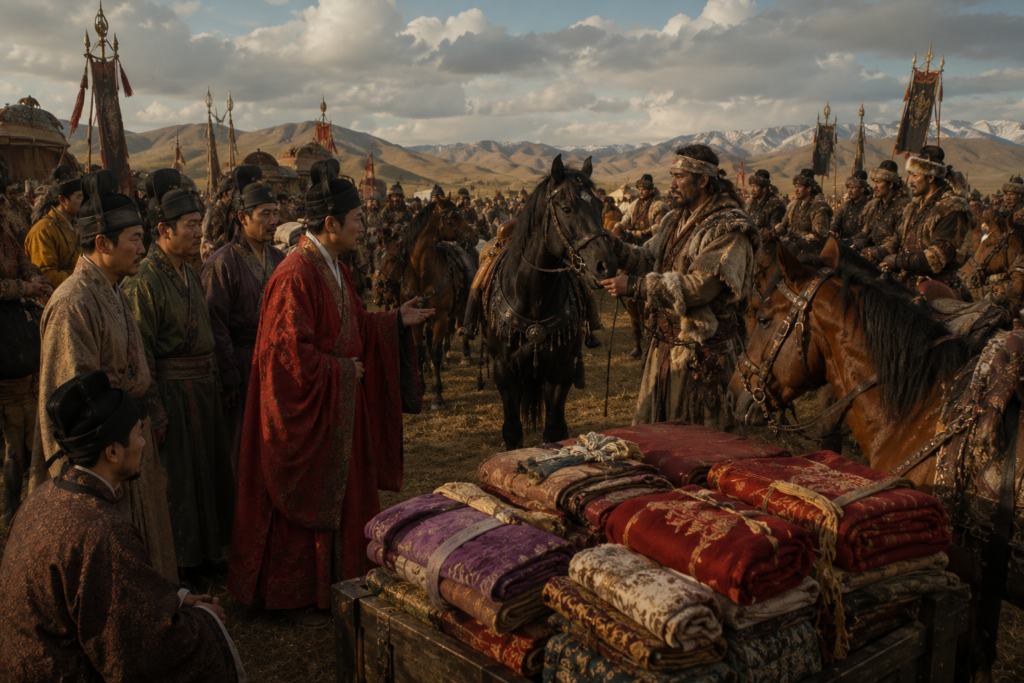
At first glance, trading silk for horses sounds like a fantastic bargain.
One side provides beautiful fabric. The other side provides animals. Everybody wins.
But for centuries, the relationship between China and the nomadic powers of Central Asia revealed something far more complicated. During the Tang Dynasty, one of the most powerful empires in the world found itself trapped in a strategic dependency that would feel surprisingly familiar today.
China desperately needed horses.
The steppe peoples desperately wanted silk.
Neither side could easily produce what the other possessed.
That simple reality created one of history’s most important and dangerous trade relationships, a system that helped shape military campaigns, diplomacy, imperial strategy, and the balance of power across Asia for centuries.
What makes the story fascinating is not simply the trade itself.
It is the fact that the mighty Tang Empire, despite its wealth, population, technology, and administrative sophistication, could not solve a critical military problem on its own. It depended heavily on peoples living beyond its borders for access to one of the most important strategic resources of the era.
The situation feels remarkably modern.
Today nations worry about oil supplies, semiconductor production, rare earth minerals, and critical industrial inputs. Governments constantly debate the risks of relying on foreign powers for resources considered essential to national security.
The Tang Dynasty faced a similar dilemma.
The resource was different.
The strategic problem was exactly the same.
Why Horses Were So Important
Modern people often underestimate the military importance of horses before industrialization.
For most of human history, horses were not simply transportation. They were strategic assets capable of determining whether empires survived or collapsed. Cavalry units provided speed, mobility, communication, reconnaissance, and battlefield power that could not easily be replaced by infantry alone.
The Tang Dynasty understood this perfectly.
Founded in 618 AD, the Tang Dynasty became one of China’s greatest imperial periods. Its armies expanded Chinese influence deep into Central Asia, secured major trade routes, and projected power across enormous territories.
But maintaining that power required horses.
A lot of horses.
Military campaigns consumed them constantly through combat, disease, exhaustion, accidents, and natural mortality. The larger the empire became, the greater the demand grew.
This created a serious problem.
The best horses generally came from the grasslands and steppes north and west of China rather than from the densely populated agricultural regions where most Chinese economic activity concentrated.
The empire needed access to animals it struggled to produce domestically in sufficient numbers.
Why the Steppe Produced Better Horses
Geography explains much of the story.
The vast Eurasian steppe stretched across enormous areas of Central Asia and supported societies built around horsemanship for generations. Nomadic peoples spent centuries breeding, training, and raising horses adapted for warfare, endurance, and long-distance travel.
These animals were exceptional.
Steppe horses often proved tougher, more resilient, and better suited for military operations than horses available in many agricultural regions. Entire cultures developed around mounted mobility in ways settled empires found difficult to replicate.
This is one of the most interesting patterns in history.
People often assume technological sophistication automatically creates superiority. But again and again, relatively simple societies developed highly specialized advantages that even enormous empires struggled to reproduce.
The Tang Dynasty could build cities, administer millions of people, and produce extraordinary artistic and scientific achievements.
Yet it still needed horses from communities living beyond imperial control.
That dependence became a strategic vulnerability.
Silk: China’s Perfect Trade Weapon
Fortunately for China, it possessed something equally valuable.
Silk.
Few products in the ancient world carried more prestige than Chinese silk. The fabric became synonymous with luxury across Asia, the Middle East, and parts of Europe. Its quality, rarity, and beauty made it one of the most desired trade goods on Earth.
For nomadic elites, silk served multiple purposes.
It functioned as:
- Luxury clothing
- Diplomatic gifts
- Status symbols
- Political rewards
- Trade commodities
- Markers of prestige
The Tang government quickly realized silk could become a powerful diplomatic tool.
Rather than relying entirely on military conquest, Chinese officials often used silk strategically to maintain relationships with neighboring peoples. Silk payments, tribute arrangements, and trade agreements became essential components of frontier policy.
The famous horse-for-silk trade emerged naturally from these conditions.
China needed horses.
The steppe wanted silk.
Both sides possessed leverage.
How the Silk-for-Horses System Worked
The basic arrangement was straightforward.
Chinese authorities exchanged large quantities of silk for horses supplied by nomadic groups and neighboring states. Various forms of the system existed throughout different periods, involving multiple steppe powers and regional political actors.
The scale became enormous.
Thousands of horses could change hands through these exchanges. Silk effectively functioned as a strategic currency allowing China to acquire military resources without direct conquest.
| Characteristic | Silk-for-Horses Trade |
|---|---|
| Main Chinese Export | Silk |
| Main Import | Horses |
| Peak Period | Tang Dynasty |
| Strategic Purpose | Military readiness |
| Trading Partners | Steppe peoples and Central Asian states |
| Chinese Dependency | Access to cavalry horses |
| Foreign Dependency | Access to luxury silk |
| Long-Term Impact | Shaped frontier diplomacy |
The system appears simple on paper.
In reality, it generated enormous political complications.
Whenever one side controls a resource the other considers essential, power becomes difficult to balance.
That was exactly the challenge facing the Tang Dynasty.
The Danger of Strategic Dependence
The horse trade exposed a weakness many empires hate admitting.
Powerful states are often less self-sufficient than they appear.
The Tang government could not simply command horses into existence. Breeding programs helped, but domestic production rarely met military demand fully. This forced Chinese leaders into ongoing negotiations with groups that were sometimes allies, sometimes rivals, and occasionally outright enemies.
The relationship became uncomfortable.
Nomadic powers understood their leverage. They knew Chinese armies required horses. That knowledge gave them negotiating power disproportionate to their population size or economic output.
This dynamic still exists today.
Countries dependent on imported oil often tolerate difficult political relationships because alternatives are limited. Nations requiring foreign semiconductors face similar constraints. Strategic dependence forces compromises regardless of military strength.
The Tang Dynasty experienced exactly this problem.
Economic necessity often overruled political preference.
When Trade and Conflict Happened Simultaneously
One of the most fascinating aspects of the silk-for-horses relationship is that trade frequently continued even when political tensions remained high.
This surprises many modern readers.
People often imagine commerce and conflict as opposites. History shows the opposite is frequently true. Rivals regularly trade with one another because economic incentives remain powerful even when political trust is weak.
The Tang frontier demonstrated this repeatedly.
Different steppe confederations alternated between cooperation, competition, alliance, and warfare. Yet commercial relationships often survived despite shifting political circumstances.
The logic was practical.
China still needed horses.
The steppe still wanted silk.
Both sides benefited enough economically that trade often continued despite broader tensions.
The modern world offers countless parallels.
Countries compete strategically while maintaining extensive commercial ties. Economic interdependence can reduce conflict in some situations while increasing vulnerability in others.
The Tang experience illustrates both possibilities simultaneously.
Why the Tang Dynasty Could Not Fully Solve the Problem
Many emperors attempted reducing dependence on foreign horse supplies.
Breeding programs expanded.
Government ranches grew larger.
Military reforms sought alternative solutions.
Yet the problem never fully disappeared.
This is perhaps the most fascinating lesson in the entire story.
History is full of examples where different societies started from relatively similar conditions but developed unique advantages over time. Geography, culture, incentives, and specialization gradually pushed groups in different directions.
The steppe peoples became masters of mounted life.
China became a master of administration, agriculture, manufacturing, and state organization.
Neither path was inherently superior.
Each produced strengths the other lacked.
The resulting interdependence became almost unavoidable.
That reality often frustrates empires because it reveals limits to their power.
No matter how strong the Tang Dynasty became, it could not easily eliminate the need for resources controlled by others.
Silk-for-Horses vs. Modern Strategic Trade
The similarities between the Tang trade system and modern resource dependencies are striking.
| Tang Dynasty | Modern World |
|---|---|
| Silk exchanged for horses | Industrial goods exchanged for critical resources |
| Military dependence on imports | Strategic dependence on key imports |
| Frontier diplomacy shaped trade | Geopolitics shapes supply chains |
| Rivals continued trading | Rivals still trade today |
| Resource leverage influenced negotiations | Resource leverage still influences negotiations |
| Economic interdependence created risks | Globalization creates similar risks |
The technology changed dramatically.
The strategic logic barely changed at all.
Governments still spend enormous effort trying to secure reliable access to resources they consider essential. The products differ, but the underlying challenge remains remarkably familiar.
What the Horse Trade Reveals About Human Progress
The silk-for-horses system reveals something fascinating about how societies evolve.
The most successful civilizations are not always those possessing every advantage. More often, success comes from developing specific strengths better than competitors.
The Tang Dynasty excelled in administration, culture, manufacturing, and economic organization.
The steppe peoples excelled in horsemanship, mobility, and animal breeding.
Both emerged from the same broader human story yet specialized in very different directions.
That divergence created trade.
It also created dependence.
And sometimes it created conflict.
The relationship demonstrates how human progress rarely unfolds evenly. Different societies solve different problems exceptionally well, creating a world where exchange becomes necessary because no single group masters everything simultaneously.
Conclusion
The silk-for-horses trade during the Tang Dynasty was far more than a simple commercial arrangement.
It represented a strategic bargain between one of history’s greatest empires and neighboring peoples who controlled a resource China desperately needed. Silk flowed outward. Horses flowed inward. The exchange helped sustain military power, diplomatic relationships, and frontier stability across vast regions of Asia.
At the same time, the arrangement exposed an uncomfortable truth.
Even the most powerful empires possess weaknesses.
The Tang Dynasty could produce magnificent cities, advanced administration, and some of the world’s most valuable luxury goods. Yet it still depended on outsiders for a military resource it could not adequately replace on its own.
That reality feels surprisingly modern.
Technology changes. Resources change. Empires rise and fall.
But powerful societies still find themselves relying on people they cannot fully control, trading for resources they cannot easily replace, and discovering that strength alone rarely guarantees independence.
References
- Beckwith, Christopher I. Empires of the Silk Road. Princeton University Press, 2009.
- Twitchett, Denis; Fairbank, John K. The Cambridge History of China, Volume 3: Sui and Tang China. Cambridge University Press, 1979.
- Barfield, Thomas. The Perilous Frontier: Nomadic Empires and China. Blackwell Publishing, 1989.
- Di Cosmo, Nicola. Ancient China and Its Enemies: The Rise of Nomadic Power in East Asian History. Cambridge University Press, 2002.
- Hansen, Valerie. The Silk Road: A New History. Oxford University Press, 2012.
The Tang Dynasty’s silk-for-horses trade revealed how even powerful empires can become strategically dependent on resources controlled by rivals.