
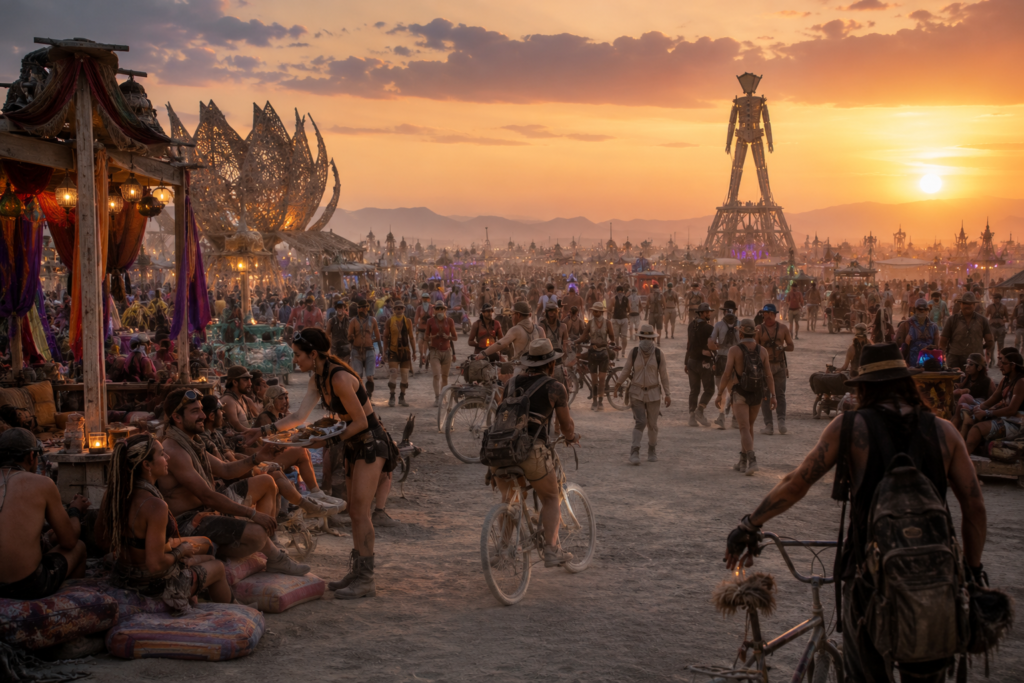
Every year, tens of thousands of people voluntarily travel into one of the harshest environments in the United States and attempt something that sounds economically impossible.
They build a temporary city in the Nevada desert where traditional commerce is officially banned.
No stores.
No restaurants selling food.
No advertisements.
No normal market economy operating the way modern society expects.
And somehow, for a short period, it works.
Burning Man, the massive annual gathering held in Nevada’s Black Rock Desert, has evolved far beyond a music festival or artistic event. At its peak, Black Rock City becomes a functioning temporary metropolis complete with roads, infrastructure, camps, transportation systems, medical services, bars, performances, and social networks supporting tens of thousands of participants. Yet the event publicly defines itself around principles rejecting ordinary commercial exchange inside the city itself.
That immediately raises a fascinating question:
What actually happens economically when a large population tries to operate without normal commerce?
The answer turns out to be far more complicated than the idealistic version people often imagine. Burning Man did not eliminate economics. It simply transformed economics into something more social, symbolic, performative, and informal. Trade still happens indirectly. Status still emerges. Scarcity still matters. Prestige still exists. Human beings still organize themselves around access, reputation, influence, and exchange even when money itself becomes less visible.
In many ways, Burning Man reveals something deeply important about human nature.
People may temporarily reject formal commerce, but economic behavior almost always reappears in some form because exchange itself is inseparable from how societies function. The structure changes. The instincts usually remain.
What Exactly Is Burning Man?
Burning Man began in 1986 as a relatively small gathering organized by Larry Harvey and a group of friends on Baker Beach in San Francisco. Over time, the event expanded dramatically before eventually relocating to Nevada’s Black Rock Desert, where it evolved into the enormous temporary city known today as Black Rock City.
The event usually lasts around one week near the end of summer.
Participants construct an enormous temporary urban environment from scratch in extremely difficult desert conditions involving intense heat, dust storms, isolation, and limited infrastructure. After the event ends, participants dismantle the city almost completely, following a principle called “Leave No Trace.”
Burning Man promotes several core cultural principles, including:
- Radical self-reliance
- Gifting
- Decommodification
- Participation
- Communal effort
- Radical inclusion
The principle most relevant economically is decommodification.
Inside Black Rock City, traditional buying and selling is intentionally minimized. Participants are encouraged to gift goods, experiences, food, performances, drinks, and services freely without direct monetary exchange.
At least officially.
That distinction matters more than it initially appears.
Why Burning Man Rejects Traditional Commerce
The anti-commerce philosophy behind Burning Man emerged partly as a reaction against modern consumer culture.
Organizers and long-term participants often describe the event as an attempt to create temporary social conditions less dominated by advertising, profit motives, branding, and transactional relationships. The idea is that removing constant commercial pressure allows people to interact more authentically and creatively.
That vision attracts enormous fascination because modern life feels deeply commercialized to many people.
Almost every public space today contains advertising, monetization systems, subscriptions, sponsorships, and transactional interactions. Many people feel exhausted by environments where every interaction eventually turns into a purchase opportunity.
Burning Man attempts to interrupt that pattern temporarily.
Participants are expected to bring their own supplies, contribute voluntarily to the community, and engage socially without constantly calculating direct financial exchange. Camps offer free coffee, drinks, performances, music, workshops, art installations, or experiences simply because participants choose to contribute them.
At least on the surface, this creates the feeling of an alternative economy operating outside ordinary capitalism.
But underneath, economic reality remains extremely present.
The Hidden Economics of a “Moneyless” City
Burning Man may reject commerce inside the city itself, but participating often requires substantial money before arrival even begins.
Tickets can cost hundreds of dollars. Transportation, camping equipment, generators, water systems, food, art projects, vehicles, costumes, and infrastructure investments can push total costs into the thousands or even tens of thousands for some participants.
This creates an interesting contradiction.
A city attempting to minimize visible commerce still depends heavily on external market systems to exist at all. Wealthier participants often possess major advantages because they can build larger camps, transport more resources, create more elaborate experiences, and contribute more visibly to the temporary society.
Money never fully disappears.
It simply becomes less directly visible inside everyday interactions during the event itself.
This reveals one of the most important truths about alternative economies historically: removing formal transactions does not eliminate underlying resource inequality. It only changes how those inequalities express themselves socially.
| Characteristic | Burning Man Economy |
|---|---|
| Location | Black Rock Desert, Nevada |
| Event Duration | Approximately one week |
| Core Economic Principle | Gifting over commerce |
| Traditional Commerce | Officially minimized |
| Main Internal Exchange | Gifts and participation |
| External Dependency | High financial costs before entry |
| Social Currency | Reputation, creativity, contribution |
| Economic Reality | Informal exchange systems still emerge |
The deeper you study Burning Man, the more obvious it becomes that human beings continuously recreate social hierarchies and exchange systems even inside environments explicitly designed to resist them.
The Gifting Economy Inside Black Rock City
The gifting culture at Burning Man is one of its most famous and misunderstood aspects.
Participants distribute food, drinks, art, performances, music, experiences, transportation, repairs, emotional support, and countless other forms of contribution without expecting direct payment. Some camps specialize entirely around offering specific experiences freely to strangers.
This creates moments that genuinely feel different from ordinary urban life.
A person might receive coffee from one camp, attend a free performance elsewhere, borrow tools from strangers later, and end the night at a large art installation built entirely through volunteer effort. The city can temporarily feel unusually generous compared to normal commercial environments where almost every interaction involves pricing structures.
But even gifting systems develop social dynamics resembling economic behavior.
People quickly gain reputations based on what they contribute. Camps become known for prestige, exclusivity, creativity, or influence. Certain experiences attract status naturally. Participants exchange not necessarily money, but visibility, access, recognition, and social capital constantly.
That is why fully escaping economics becomes almost impossible.
Humans naturally create value systems inside every organized society.
Why Status Still Exists Without Money
One of the most fascinating parts of Burning Man is how quickly symbolic status systems emerge despite the anti-commercial philosophy.
Certain camps become famous.
Certain art installations attract prestige.
Certain participants gain social influence through creativity, resources, or visibility.
This mirrors patterns appearing throughout human history repeatedly.
Even societies attempting to minimize wealth differences often recreate hierarchy through alternative forms of status. If money becomes less important temporarily, people start valuing other things more intensely:
- Artistic contribution
- Reputation
- Exclusivity
- Social connections
- Access to experiences
- Creative visibility
- Community influence
The mechanism itself barely changes.
Only the currency changes.
This is why many alternative economies eventually drift back toward more traditional systems over time. Human beings naturally organize around exchange, scarcity, prestige, and differentiation. Completely eliminating those instincts appears extraordinarily difficult at large scale.
Burning Man demonstrates this tension constantly.
The city rejects ordinary capitalism rhetorically while simultaneously generating new forms of symbolic and social capital internally.
Scarcity Never Fully Disappears
The Nevada desert is an unforgiving environment.
Water remains limited. Shade matters enormously. Transportation can become difficult. Dust storms disrupt movement constantly. Physical exhaustion accumulates quickly under extreme heat and isolation.
Scarcity therefore remains central to daily life even without traditional markets operating openly.
This creates fascinating social behavior.
Participants depend heavily on preparation, networks, cooperation, and reciprocal goodwill because survival conditions remain physically demanding. Camps with stronger infrastructure often become highly influential socially because they provide comfort, resources, or experiences others want access to.
Again, economics quietly reappears.
Not necessarily through direct transactions, but through access to resources, logistics, labor, and social coordination.
This is one reason many attempts to create fully post-economic societies historically struggle long term. Scarcity itself does not disappear simply because formal money becomes less visible.
People still need food, water, shelter, transportation, labor, and infrastructure.
The organizational challenges remain fundamentally economic even when ideology changes.
Burning Man vs. Traditional Economies
The comparison between Burning Man and ordinary cities reveals how deeply commerce shapes modern civilization.
| Traditional City | Burning Man |
|---|---|
| Market transactions dominate | Gifting emphasized |
| Businesses compete commercially | Camps contribute voluntarily |
| Advertising everywhere | Commercial branding restricted |
| Status tied heavily to wealth | Status tied more to contribution and visibility |
| Permanent infrastructure | Temporary infrastructure |
| Formal labor markets | Volunteer participation |
| Monetary exchange constant | Informal social exchange systems |
But the similarities may actually matter more than the differences.
Both systems still depend on:
- Resource allocation
- Social coordination
- Infrastructure
- Scarcity management
- Reputation
- Labor contribution
- Hierarchies of influence
Burning Man did not eliminate economics.
It exposed how flexible economic behavior can become under different cultural rules.
Why Alternative Economies Usually Drift Back Toward Traditional Systems
One of the clearest lessons from Burning Man is that societies naturally tend to recreate familiar economic structures over time.
Even when formal commerce disappears temporarily, people continue organizing socially around value exchange. Some participants contribute more resources than others. Some gain prestige through visibility. Certain camps become highly desirable socially. Informal influence networks emerge constantly.
This does not necessarily mean the experiment fails.
In many ways, Burning Man succeeds precisely because it reveals how adaptable human economies really are. The event demonstrates that people can temporarily reduce direct monetization and still maintain surprisingly large social systems through cooperation and gifting behavior.
But long-term sustainability becomes harder.
Large societies eventually require coordination mechanisms handling scarcity, incentives, infrastructure, labor specialization, and resource distribution efficiently. Historically, markets and monetary systems evolved largely because they solve those organizational problems effectively at scale.
Burning Man works partly because it remains temporary.
The temporary nature allows participants to tolerate inefficiencies, symbolic systems, and experimental behavior more easily than permanent civilizations usually can.
What Burning Man Reveals About Human Nature
Burning Man reveals something deeply consistent about human societies.
People may criticize commerce constantly, but exchange itself appears inseparable from organized civilization. Humans naturally create systems assigning value, status, prestige, and access regardless of whether formal money exists visibly inside the structure.
Even anti-commercial environments eventually generate alternative currencies socially.
Sometimes those currencies involve reputation.
Sometimes creativity.
Sometimes influence, access, visibility, or contribution.
The form changes constantly.
The underlying behavior remains remarkably stable.
The event also exposes how strongly modern people crave temporary escape from nonstop commercialization. Burning Man’s popularity reflects widespread exhaustion with transactional urban life where nearly every interaction eventually becomes monetized.
Yet the experiment simultaneously demonstrates how difficult it is to fully escape traditional economic instincts for long.
Human beings seem wired to rebuild exchange systems almost automatically.
Conclusion
Burning Man became one of the world’s most fascinating temporary economic experiments because it attempted something most modern societies barely consider possible anymore: operating a large city while minimizing visible commerce.
For a short period each year, Black Rock City transforms the Nevada desert into a functioning social environment built heavily around gifting, participation, communal effort, and symbolic contribution rather than ordinary market exchange.
And remarkably, it works.
At least temporarily.
But the deeper reality becomes more complicated the closer you look. Money never fully disappears from the system. Wealth differences still shape participation. Scarcity still exists. Status still emerges. Informal exchange systems quietly replace formal ones almost immediately.
The city does not eliminate economics.
It reveals how deeply economic behavior is embedded inside human social organization itself.
Burning Man ultimately shows that societies may reject traditional commerce temporarily, but humans almost always recreate systems of value, exchange, prestige, and hierarchy in one form or another.
References
- Harvey, Larry. The Ten Principles of Burning Man. Burning Man Project.
- Doherty, Brian. This Is Burning Man: The Rise of a New American Underground. Little, Brown and Company, 2004.
- “Burning Man Project Official Website.” Acesso em: maio de 2026. Disponível em: https://burningman.org
- Gilmore, Lee. Theater in a Crowded Fire: Ritual and Spirituality at Burning Man. University of California Press, 2010.
- Turner, Fred. From Counterculture to Cyberculture. University of Chicago Press, 2006.
Burning Man’s temporary desert city reveals how humans recreate exchange, status, and informal economies even without traditional commerce.