
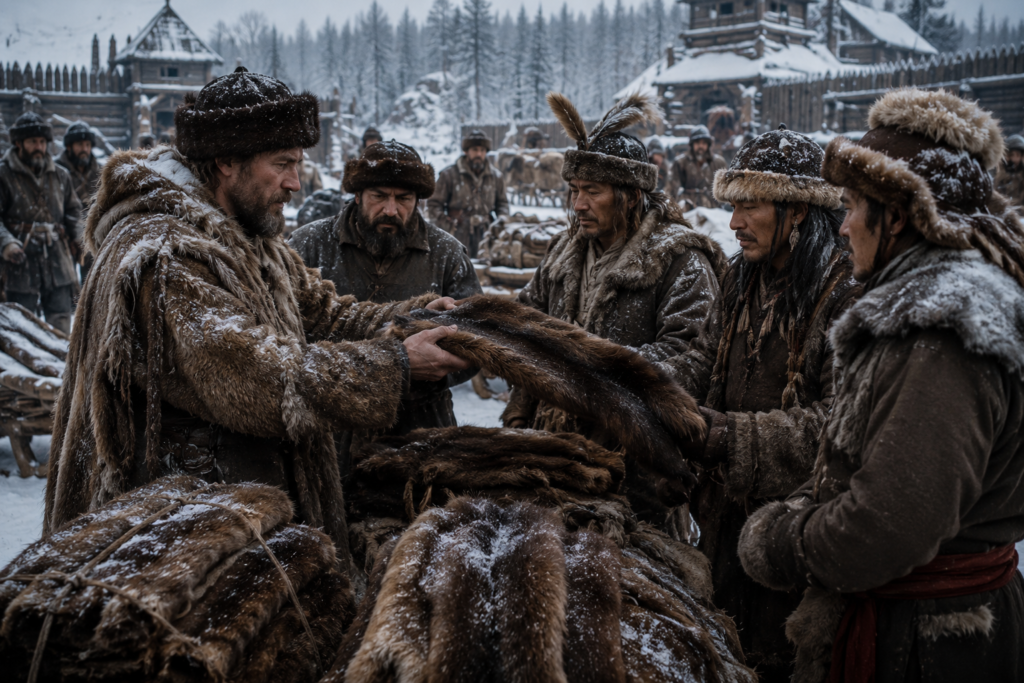
For centuries, Russia helped build an empire using animal skins.
Not gold.
Not silver.
Not oil.
Fur.
At first, this sounds almost absurd to modern ears. It feels strange imagining entire economies functioning around sable pelts, fox skins, and Arctic animal furs moving through frozen trade routes across Siberia. But for long periods of Russian history, fur operated almost like a parallel currency system powerful enough to finance expansion, taxation, diplomacy, and international commerce.
The Russian state became deeply dependent on it.
European elites desperately wanted luxury furs during the medieval and early modern periods. Fashion transformed animal pelts into high-status goods associated with wealth, nobility, and prestige. That demand turned Siberia into one of the most economically valuable regions on Earth despite its brutal climate and extreme isolation.
And the consequences were enormous.
Russian expansion eastward across Siberia accelerated partly because fur profits became too lucrative to ignore. Hunters, traders, soldiers, and state officials pushed deeper into frozen territories searching for sable, ermine, fox, and other valuable animals whose skins circulated almost like monetary assets.
The deeper you study the story, the more uncomfortable it becomes.
Humans repeatedly build entire economic systems around objects that later generations view as bizarre or morally disturbing. Luxury fashion based on animal suffering once generated immense geopolitical importance. Even today, people continue paying enormous prices for status goods whose practical utility barely justifies their cost.
Designer clothing, luxury watches, exotic materials, and fur coats still reveal the same instinct operating underneath:
Humans often value prestige more than necessity.
The Siberian fur economy simply pushed that logic to imperial scale.
Why Fur Became So Valuable
Fur mattered because Europe’s climate and social structures made it desirable long before industrial heating existed.
Warm clothing was necessary in colder regions, but luxury fur went far beyond practical survival. Certain pelts became status symbols associated with nobility, political authority, and elite identity. Sable fur especially gained extraordinary prestige due to its softness, rarity, and dark glossy appearance.
This created massive demand.
Wealthy Europeans wanted expensive fur garments partly because the materials communicated status publicly. Owning rare pelts demonstrated access to wealth, trade connections, and social rank.
That psychological mechanism still exists today.
Luxury fashion often functions less around practical utility and more around signaling exclusivity or prestige. Expensive brand clothing rarely performs dramatically better than ordinary alternatives functionally. What buyers often purchase instead is symbolic status.
The fur economy operated similarly.
Several animals became especially valuable:
- Sable
- Arctic fox
- Ermine
- Beaver
- Lynx
- Marten
Their pelts circulated through massive trade networks connecting Siberia, Russia, Europe, China, and Central Asia.
In many cases, furs became so economically important they effectively behaved like monetary instruments themselves.
Siberia: The Frozen Gold Mine
When Russians expanded eastward beginning heavily during the sixteenth century, Siberia appeared harsh, distant, and almost unimaginably difficult to control.
But underneath the brutal environment was extraordinary wealth.
The forests and frozen landscapes contained enormous populations of fur-bearing animals highly valued in international markets. The Russian state quickly realized Siberia represented something like a giant renewable resource frontier capable of generating enormous profits.
This realization transformed Russian imperial strategy.
Cossacks, traders, hunters, and state representatives pushed deeper across Siberia establishing forts, settlements, and trading networks tied directly to fur extraction. Rivers became commercial highways moving pelts westward toward European markets.
The scale was astonishing.
Russia eventually crossed thousands of miles of wilderness partly driven by fur demand alone. Expansion reached the Pacific Ocean and later even extended into Alaska during the Russian colonial period.
Fur financed empire.
| Characteristic | Siberian Fur Economy |
|---|---|
| Main Resource | Animal pelts |
| Key Region | Siberia |
| Peak Expansion | 16th–18th centuries |
| Major Luxury Fur | Sable |
| Main Buyers | European and Asian elites |
| Economic Function | Trade, taxation, wealth storage |
| Political Impact | Fueled Russian expansion |
| Main Trade Routes | Rivers and overland caravans |
The environment made the system even more brutal.
Hunters operated in extreme cold, isolation, and dangerous terrain where survival itself remained difficult long before industrial infrastructure existed.
Fur Taxes and the Yasak System
One of the most important parts of the Siberian fur economy involved taxation.
The Russian Empire imposed a tribute system known as yasak on many Indigenous Siberian populations. Rather than paying taxes primarily in coinage, communities often delivered valuable furs directly to Russian authorities.
This transformed animal pelts into state revenue.
The system worked because furs already possessed reliable international value. The Russian government could collect sable pelts in Siberia and convert them into wealth through trade networks stretching across Europe and Asia.
The economic logic resembled commodity-backed taxation.
Indigenous populations frequently faced enormous pressure under the system. Russian authorities demanded quotas, enforced tribute collection, and expanded political control partly to secure continued access to fur resources.
This is where the darker side of the story becomes impossible to ignore.
Entire populations became economically tied to large-scale animal exploitation driven heavily by elite luxury demand thousands of miles away.
That dynamic feels disturbingly modern in some ways.
Poorer countries today often remain heavily dependent on resource extraction industries serving wealthier global markets. The commodities change — oil, minerals, agriculture, rare metals — but the structural imbalance often remains familiar.
Fur as Currency
In some regions and contexts, fur effectively operated as money.
Pelts stored value, facilitated trade, paid taxes, settled obligations, and functioned as widely recognized economic assets. Sable skins became especially trusted because of consistent demand and relatively stable prestige value.
This was practical economically.
Coins remained difficult to transport across remote Siberian frontiers during earlier periods. Fur, meanwhile, already possessed immediate desirability and broad recognition across commercial networks.
People understood its worth instantly.
That is one of the oldest requirements for successful money systems.
The object must be socially trusted.
Fur met several monetary conditions surprisingly well:
- Portable relative to value
- Difficult to counterfeit
- High demand
- Durable when preserved properly
- Broadly recognized
- Exchangeable internationally
The system reveals how flexible human economies become under frontier conditions.
People repeatedly transform whatever resources hold stable social value into monetary instruments when traditional financial infrastructure remains weak or impractical.
The Human and Environmental Cost
The Siberian fur economy generated enormous suffering both for animals and human populations.
Hunting expanded aggressively across vast ecosystems as demand intensified. Sable populations declined heavily in some regions due to overhunting. Entire ecological systems experienced pressure from large-scale extraction focused almost entirely on luxury consumption.
That part feels especially disturbing today.
Millions of animals died largely to satisfy elite fashion demand and status signaling. People endured brutal climates, dangerous expeditions, and violent imperial expansion partly so aristocrats could wear prestigious fur garments in European courts.
The imbalance becomes hard to ignore once you see it clearly.
Several consequences emerged:
- Ecological depletion
- Indigenous exploitation
- Violent territorial expansion
- Harsh frontier labor
- Resource dependency
- Concentration of wealth through luxury demand
The fur economy exposed how often global commerce disconnects consumers psychologically from the suffering behind products themselves.
Modern supply chains still create similar moral distance constantly.
Why the Fur Economy Eventually Declined
The Siberian fur economy gradually weakened for multiple reasons.
First, overhunting reduced animal populations in many regions, making extraction less sustainable long term. Second, industrialization transformed economic structures and reduced dependence on traditional luxury trade systems.
New industries became more important.
Russia increasingly shifted toward broader industrial and resource-based development over time. Railroads, manufacturing, agriculture, and later oil and mineral extraction gradually overshadowed fur economically.
Fashion also evolved.
Although luxury fur never disappeared completely, its central importance weakened relative to earlier centuries when aristocratic identity relied heavily on visible material status symbols like rare pelts.
The system eventually became less capable of sustaining imperial-scale expansion economically.
Still, the legacy remained enormous.
Fur profits helped shape Russia’s territorial expansion across Eurasia permanently.
The Siberian Fur Economy vs. Modern Resource Economies
The parallels between the fur trade and modern commodity economies are striking.
| Siberian Fur Economy | Modern Resource Economies |
|---|---|
| Depended on natural extraction | Same structural dependence |
| Fueled imperial expansion | Resources still shape geopolitics |
| Luxury demand drove profits | Consumer demand still drives markets |
| Frontier exploitation expanded rapidly | Same dynamic appears globally |
| Wealth concentrated around exports | Resource economies still face this |
| Ecological damage followed | Environmental costs remain central |
The psychological similarities matter too.
People continue assigning enormous value to status goods partly disconnected from practical necessity. Luxury markets still depend heavily on exclusivity, symbolism, and social prestige rather than pure functionality.
The materials simply changed.
What the Fur Ruble Reveals About Human Nature
The Siberian fur economy reveals how easily societies normalize exploitation once prestige and wealth become involved.
Millions of animals died because elite consumers valued symbolic luxury enough to sustain enormous extraction systems across frozen continents. Entire imperial structures expanded partly around the economics of status consumption.
That sounds irrational initially.
But modern societies still operate similarly constantly.
Luxury industries continue generating massive wealth from products whose primary value lies more in symbolism than utility. People routinely pay extraordinary prices for objects communicating exclusivity, identity, or social rank.
The fur economy simply made this dynamic more visible.
The story also reveals how flexible money becomes historically. Humans repeatedly transform valuable commodities into quasi-currencies whenever social trust and practical conditions support the transition.
Fur worked because societies collectively agreed it worked.
That pattern never truly disappeared.
Conclusion
The Siberian fur economy helped transform Russia into a massive Eurasian empire built partly on animal pelts functioning as wealth, taxation, trade assets, and quasi-currency.
Sable, fox, ermine, and other furs circulated through enormous commercial networks because European elites attached extraordinary value to luxury pelts associated with prestige and status. The resulting demand pushed Russian expansion thousands of miles across Siberia in pursuit of profitable extraction.
The system generated enormous wealth.
It also generated enormous suffering.
Animals were hunted relentlessly, Indigenous populations faced tribute systems and imperial pressure, and entire ecosystems were reshaped largely to satisfy luxury consumption far away from the frozen frontiers where the extraction occurred.
The story still feels strangely modern because human economies continue operating through many of the same instincts. Status, symbolism, prestige, and resource dependency still shape global markets constantly.
The products changed.
The psychology barely changed at all.
Russia’s forgotten fur economy turned Siberian animal pelts into wealth, taxation, and quasi-currency that helped finance imperial expansion.
References
- Forsyth, James. A History of the Peoples of Siberia. Cambridge University Press, 1994.
- Lincoln, W. Bruce. The Conquest of a Continent: Siberia and the Russians. Cornell University Press, 2007.
- “The Russian Fur Trade.” Encyclopaedia Britannica. Acesso em: maio de 2026. Disponível em: https://www.britannica.com
- Martin, Janet. Treasure of the Land of Darkness: The Fur Trade and Its Significance for Medieval Russia. Cambridge University Press, 1986.
- “Sable Fur and the Expansion of Russia.” World History Encyclopedia. Acesso em: maio de 2026.
The Siberian fur trade transformed animal pelts into a powerful economic system that financed Russian expansion across Eurasia.