
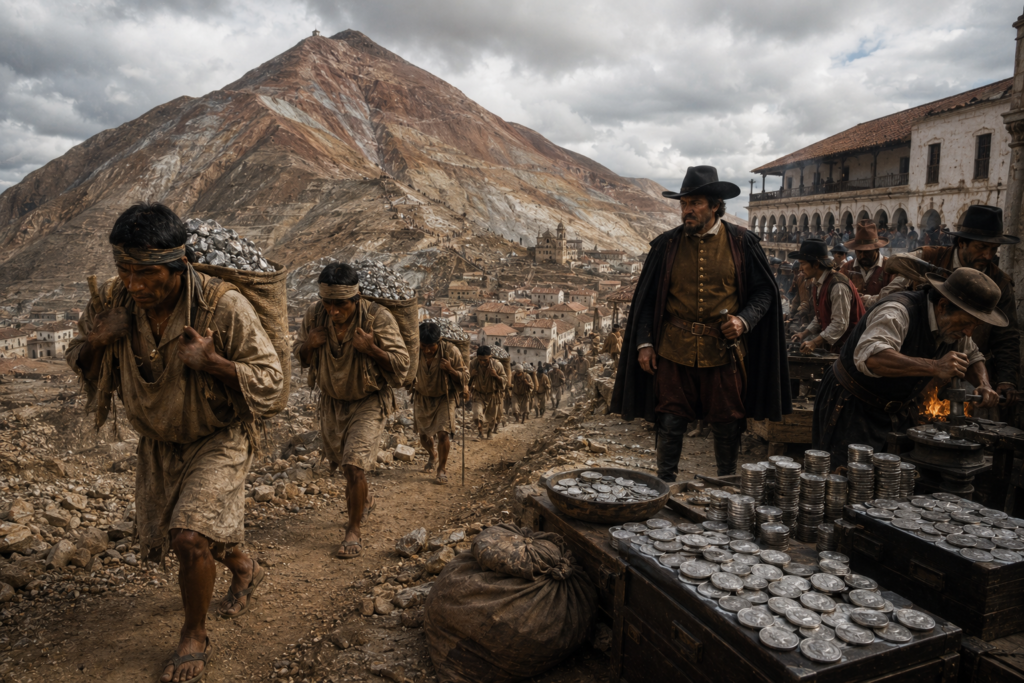
There is a mountain in Bolivia that may have changed the entire global economy more than almost any place on Earth.
At first glance, Cerro Rico looks like just another mountain rising above the city of Potosí in the Andes. But after Spanish colonizers discovered massive silver deposits there in 1545, the mountain transformed into something far more important.
It became an engine feeding the first truly global currency system.
For centuries, enormous quantities of silver extracted from Potosí flooded into Europe, Asia, Africa, and the Americas. The famous Spanish “pieces of eight” minted from this silver circulated across oceans so widely that they effectively became the first global currency accepted across multiple empires and trade networks.
Pirates used them.
Asian merchants demanded them.
European empires fought over them.
Colonial economies depended on them.
And millions of people suffered to produce them.
The story feels strangely modern once you step back.
Today entire economies depend heavily on strategic commodities and resources controlled by relatively specific regions. Oil, semiconductors, agricultural exports, rare earth minerals, and industrial metals all shape global power structures in ways most people barely notice during stable periods.
Brazil itself, for example, remains deeply connected to global agricultural demand.
Potosí played a similar role centuries earlier, except with silver.
The difference was the scale of human exploitation required to sustain it.
The Discovery of Cerro Rico
According to historical accounts, Spanish colonizers discovered silver in Cerro Rico around 1545 near present-day Potosí, Bolivia.
The timing could hardly have been more important for Spain.
The Spanish Empire was expanding rapidly across the Americas and desperately needed enormous financial resources to sustain military campaigns, imperial administration, global shipping, and European political ambitions. The discovery of one of the richest silver deposits in world history suddenly transformed Spain into a financial superpower.
Potosí exploded almost overnight.
What had once been a remote Andean region became one of the largest and wealthiest cities in the world during the sixteenth and seventeenth centuries. At its peak, Potosí may have reached populations exceeding many major European cities of the time.
All because of silver.
The mountain became legendary.
Spanish authorities called it Cerro Rico, meaning “Rich Mountain,” and the name was not exaggerated. Historians estimate that enormous quantities of global silver production during the early modern period originated directly from Potosí.
The consequences reshaped world trade permanently.
What Were Pieces of Eight?
The famous “pieces of eight” were Spanish silver coins formally known as Spanish dollars or eight-real coins.
Minted partly using silver from Potosí and other colonial mines, these coins became remarkably trusted across international trade networks because of their relatively consistent silver content and broad circulation.
This consistency mattered enormously.
Global commerce requires trust. Merchants operating across vast distances need currencies widely recognized, difficult to counterfeit, and relatively stable in metal value. The Spanish silver dollar solved many of these problems better than competing currencies of the era.
The coin became almost universally accepted.
Pieces of eight circulated through:
- Europe
- Spanish America
- British colonies
- China
- India
- Africa
- Caribbean trade routes
- Maritime commerce networks
In many ways, the coin functioned like an early version of a reserve currency.
Long before the modern US dollar dominated global finance, Spanish silver already connected enormous sections of the world economy through a shared monetary system.
| Characteristic | Pieces of Eight |
|---|---|
| Main Material | Silver |
| Major Source | Potosí, Bolivia |
| Introduced | 16th century |
| Main Issuer | Spanish Empire |
| Global Reach | Europe, Asia, Americas, Africa |
| Main Purpose | Trade and commerce |
| Reputation | Highly trusted silver coin |
| Historical Importance | First widely global currency |
The global scale becomes difficult to exaggerate.
Very few currencies before the Spanish dollar achieved comparable international reach.
Why China Became Obsessed With Silver
One of the most fascinating parts of the story is how much of Potosí’s silver eventually flowed toward China.
During the Ming Dynasty, China increasingly shifted toward silver-based taxation and commerce. The government’s monetary systems gradually created enormous demand for reliable silver supplies, especially after earlier paper currency disasters weakened confidence in state-issued notes.
This created a massive global pull.
Spanish silver mined in the Andes often crossed the Pacific through the Manila Galleon trade routes connecting the Americas to Asia. Merchants transported silver from Acapulco in Mexico to Manila in the Philippines, where Chinese traders eagerly exchanged silk, porcelain, spices, and luxury goods for precious metal.
This system effectively connected the world economically.
For perhaps the first time in history, large-scale trade linked the Americas, Europe, Africa, and Asia continuously through integrated monetary flows.
Potosí sat near the center of this transformation.
The mountain in Bolivia quietly helped finance commerce occurring thousands of miles away in places whose populations likely knew almost nothing about one another.
That interconnectedness feels surprisingly modern.
Today global markets also depend heavily on distant supply chains most ordinary people rarely think about until disruptions suddenly appear.
The Human Cost Behind the Silver
The wealth generated by Potosí came at horrifying human cost.
Spanish colonial authorities relied heavily on forced Indigenous labor systems adapted partly from existing Inca structures. Under the mita system, enormous numbers of Indigenous workers were compelled into brutal mining labor under catastrophic conditions.
Later, African enslaved labor also became part of the system.
The environment inside the mines was devastating.
Workers faced:
- Toxic mercury exposure
- Cave-ins
- Extreme altitude conditions
- Exhaustion
- Malnutrition
- Physical abuse
- High mortality rates
Historians still debate exact death tolls associated with Potosí over centuries, but the numbers were enormous.
Some estimates suggest millions of Indigenous workers may have died directly or indirectly through labor exploitation tied to colonial mining systems across the Andes.
This is the darker side of global monetary history.
Currencies often appear abstract and neutral centuries later. Coins sit quietly behind museum glass looking almost elegant. But many monetary systems were built through violence, forced labor, imperial extraction, and human suffering on staggering scales.
Potosí may be one of the clearest examples.
How Silver Turned Spain Into a Superpower
The silver from Potosí dramatically strengthened Spain during the sixteenth century.
Massive bullion shipments financed:
- European wars
- Naval expansion
- Colonial administration
- Royal courts
- Military campaigns
- International trade networks
Spain effectively became one of the world’s dominant powers partly because American silver allowed it to sustain imperial ambitions beyond what its domestic economy alone could support.
But the situation became complicated.
Easy access to silver created long-term distortions too.
Rather than building strong productive industries internally, Spain increasingly depended on precious metal flows to finance imports and imperial spending. Inflation spread across parts of Europe during what historians sometimes call the “Price Revolution,” partly because enormous amounts of New World silver expanded money supplies dramatically.
The pattern feels familiar today.
Resource-rich economies often experience strange long-term effects where dependence on a single lucrative export weakens broader structural development. Oil economies, commodity-dependent states, and extraction-based systems frequently struggle with similar dynamics.
Easy money can create hidden fragility.
Pirates, Smugglers, and Global Trade
Pieces of eight became legendary partly because they traveled everywhere.
Pirates targeted Spanish treasure fleets carrying silver across the Atlantic. Smugglers circulated coins through unofficial trade routes. Colonial merchants used them constantly in commerce stretching across oceans.
The coins became deeply embedded inside popular imagination.
Treasure chests filled with silver coins exist in pirate mythology largely because these coins genuinely dominated maritime trade during the period. The phrase “pieces of eight” itself survived culturally through books, films, and stories long after the original monetary system disappeared.
But behind the mythology was a serious economic reality.
The Spanish dollar became trusted because people believed its silver content remained relatively reliable across borders. That trust allowed merchants from radically different cultures and empires to transact more efficiently.
This is what makes a global currency powerful.
Not simply political authority.
Acceptance.
Pieces of Eight vs. Modern Reserve Currencies
The comparison between Spanish silver dollars and modern global reserve currencies becomes extremely interesting.
| Pieces of Eight | Modern Reserve Currencies |
|---|---|
| Backed by silver content | Backed by institutional trust |
| Accepted across empires | Accepted across nations |
| Powered global trade | Powers global trade |
| Supported imperial dominance | Supports geopolitical influence |
| Depended on resource extraction | Depends on economic and military influence |
| Symbolized global financial power | Same function today |
Many people today already suspect major currencies derive part of their strength not purely from economics, but from political and military influence as well.
Historically, this has almost always been true.
Currencies rise partly because powerful systems support them.
Spain’s silver dollar dominated because Spain controlled enormous resources, trade routes, and military infrastructure capable of sustaining trust in the coin internationally.
The modern world operates differently technologically, but power still shapes monetary dominance heavily.
Why Potosí Still Matters Today
The story of Potosí matters because it reveals how deeply global economies have always depended on concentrated resource extraction.
Modern globalization did not emerge suddenly in the twentieth century.
The foundations appeared centuries earlier through systems like silver extraction, ocean trade routes, colonial commerce, and global monetary integration. Potosí helped create one of the earliest truly interconnected world economies.
The mountain also reveals how wealth and suffering often grow together historically.
Enormous fortunes emerged from silver exports while Indigenous populations endured catastrophic exploitation simultaneously. Entire empires expanded using wealth extracted from regions forced into unequal systems of labor and trade.
That legacy never fully disappeared.
Many modern economies still rely heavily on resource extraction systems shaped partly by colonial structures established centuries ago.
Conclusion
The silver mountain of Potosí helped create the first truly global currency system in history.
Pieces of eight minted from Andean silver circulated across oceans, connected continents, financed empires, and transformed international trade permanently. For centuries, these coins became trusted almost everywhere because they represented reliable silver content backed by one of the world’s richest extraction systems.
But the wealth came at immense human cost.
Millions suffered through forced labor, exploitation, and colonial violence to sustain the silver flows feeding global commerce. The prosperity of empires and trade networks rested directly on brutal extraction hidden deep inside the mines of Cerro Rico.
The story still feels modern because global economies continue depending heavily on concentrated resources controlled by specific regions. Agricultural exports, oil reserves, semiconductors, and industrial minerals now occupy roles similar to silver centuries earlier.
Potosí reminds us that global currencies rarely emerge from economics alone.
They emerge from power, extraction, trust, violence, and the ability to convince the world that one system deserves universal acceptance.
Potosí’s silver mines created the pieces of eight, the first truly global currency that connected empires, trade routes, and continents through silver.
References
- Flynn, Dennis; Giráldez, Arturo. Born with a “Silver Spoon”: The Origin of World Trade in 1571. Journal of World History, 1995.
- Lane, Kris. Potosí: The Silver City That Changed the World. University of California Press, 2019.
- “Cerro Rico de Potosí.” UNESCO World Heritage Centre. Acesso em: maio de 2026. Disponível em: https://whc.unesco.org
- Braudel, Fernand. Civilization and Capitalism, 15th–18th Century. Harper & Row, 1982.
- “The Spanish Dollar and Global Trade.” American Numismatic Society. Acesso em: maio de 2026. Disponível em: https://numismatics.org
Pieces of eight from Potosí became the world’s first global currency, linking empires, silver mines, and international trade routes.