
Introduction
Most people learn about the Opium Wars as military conflicts between Britain and China. Cannons, naval battles, treaties, and imperial politics usually dominate the story. But the deeper you go into the history, the harder it becomes to ignore what was really happening underneath it all.
This was an economic attack long before it became a military one.
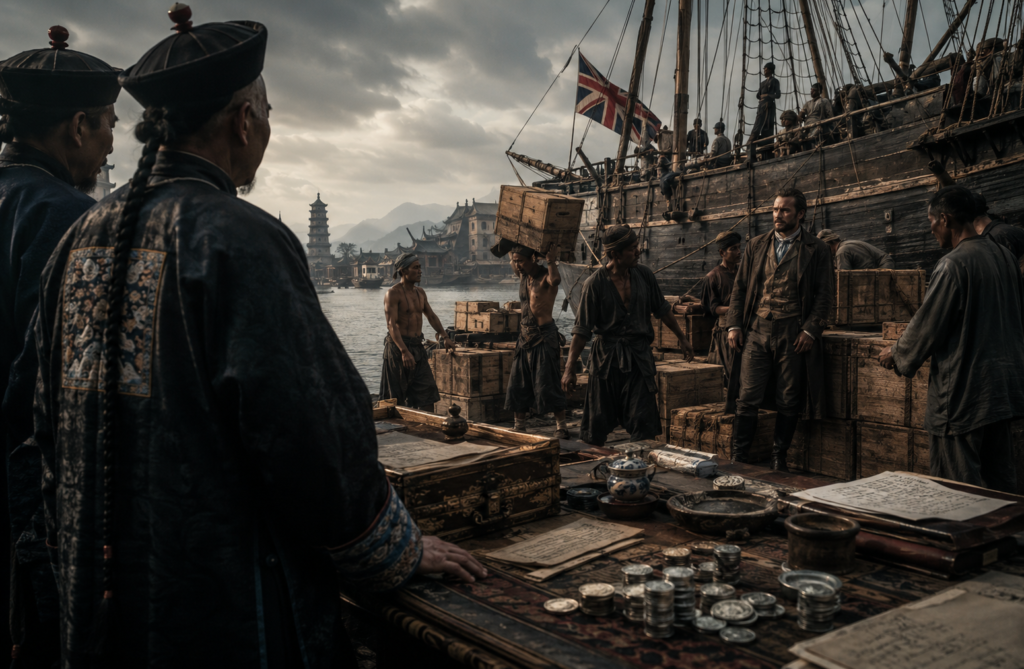
In the early nineteenth century, Britain found itself trapped in a frustrating problem with Qing China. The British desperately wanted Chinese goods like tea, porcelain, and silk, but China had little interest in buying British products in return. Silver kept flowing out of Britain and into China, creating a growing trade imbalance that alarmed British merchants and officials.
Britain eventually found a solution that was brutally effective: narcotics.
The British Empire began aggressively expanding the opium trade into China using opium produced in British-controlled India. Addiction spread rapidly across Chinese society, silver started flowing out of China instead of into it, and the Qing government slowly lost economic stability and political control.
The more you read about it, the less it feels like ancient history. Modern economies still use dependency in ways that reshape societies over time. Sometimes the product is narcotics. Other times it is ultra-cheap consumer goods, digital addiction, fast fashion, or endless streams of disposable products flooding global markets.
That is part of what makes the story so unsettling. The tools change, but the strategy of using dependency to gain economic leverage never fully disappears.
The Trade Imbalance That Frustrated Britain
By the late eighteenth century, Qing China controlled one of the largest and most productive economies in the world. European demand for Chinese goods exploded during this period, especially demand for tea. In Britain, tea consumption became deeply embedded in everyday life across social classes.
The problem for Britain was simple: China did not need much from Europe.
Under the Canton System established during the Qing dynasty, foreign merchants could only trade through limited ports and under strict regulations. Chinese merchants accepted payment largely in silver, which meant enormous quantities of silver steadily flowed into China during the eighteenth century.
British officials and merchants viewed this imbalance as a serious problem. The British East India Company spent huge amounts of silver importing Chinese tea while struggling to find products the Chinese market actually wanted.
Attempts to expand trade diplomatically failed. In 1793, the British government sent the Macartney Embassy to China hoping to negotiate broader commercial access. The Qianlong Emperor rejected many British requests and reportedly viewed European products as unnecessary luxuries.
From the Qing perspective, China remained economically self-sufficient. From the British perspective, the situation became increasingly unacceptable.
That tension laid the groundwork for one of the most destructive economic strategies of the nineteenth century.
Opium From India Changes Everything
Britain already controlled large opium production networks in India, especially in Bengal, after expanding the power of the British East India Company during the late eighteenth century. The company recognized that opium could solve Britain’s silver problem if Chinese demand could be expanded aggressively enough.
At first, opium imports into China remained relatively small. Smoking opium existed in parts of Chinese society before British involvement, but the scale changed dramatically once British merchants began industrializing the trade.
The numbers became staggering.
By the early 1800s, opium shipments into China increased rapidly each decade. Historians estimate that imports grew from around 4,500 chests annually in the 1790s to more than 40,000 chests per year by the late 1830s.
The economic effects became devastating.
Silver that had once flowed steadily into China now began flowing outward to pay for opium imports. Addiction spread through multiple layers of Chinese society, including government officials, soldiers, merchants, laborers, and scholars.
The Qing government understood the danger almost immediately. Officials repeatedly attempted to ban opium imports and punish trafficking networks, but corruption and foreign smuggling operations made enforcement increasingly difficult.
Britain’s strategy worked because it exploited several weaknesses simultaneously:
- China’s growing consumer demand for opium
- Corruption within Qing administration
- Britain’s naval dominance
- The British East India Company’s control over Indian production
- Weak enforcement across China’s vast coastline
- Economic dependency developing through addiction
The result was not simply a drug crisis. It became a large-scale financial destabilization campaign.
How the Silver Drain Worked
The term “silver drain” describes the reversal of silver flows that transformed the Qing economy during the nineteenth century. For decades, silver had entered China through trade because European merchants purchased Chinese goods in enormous quantities.
Once opium imports exploded, the direction reversed.
Chinese consumers now paid foreign merchants silver in exchange for opium. Massive amounts of precious metal began leaving the Qing economy year after year.
| Economic Shift | Before Large-Scale Opium Trade | After Opium Expansion |
|---|---|---|
| Silver Flow | Into China | Out of China |
| British Trade Position | Trade deficit with China | Trade surplus through opium |
| Chinese Government Revenue | Relatively stable | Increasing strain |
| Currency Stability | Strong silver reserves | Growing monetary instability |
| Social Effects | Limited addiction problems | Widespread addiction and corruption |
| Political Stability | Qing authority relatively strong | Qing authority weakened |
This mattered because silver played a central role inside the Qing financial system. Taxes, government payments, and commercial transactions depended heavily on silver circulation.
As silver became scarcer inside China, prices shifted unevenly across the economy. Peasants and ordinary workers struggled under growing financial pressure. Tax burdens became harder to manage, local economies destabilized, and corruption deepened throughout the bureaucracy.
The crisis exposed something that still matters in modern economics: dependency can become a geopolitical weapon.
At first, the trade relationship looked profitable for both sides. British merchants made money, Chinese consumers received a product they increasingly demanded, and trade expanded rapidly. But underneath the surface, one side was slowly becoming structurally weaker while the other gained leverage.
That dynamic feels familiar in modern discussions about ultra-cheap imports flooding foreign markets. Countries often become dependent on outside manufacturing, digital platforms, or consumer ecosystems that seem harmless at first but eventually reshape local industries and economic power structures.
The products change across history. The strategic logic often stays surprisingly similar.
Commissioner Lin Zexu and China’s Crackdown
By the late 1830s, the Qing government recognized that the situation had become catastrophic. The Daoguang Emperor appointed Commissioner Lin Zexu in 1839 to suppress the opium trade and restore order.
Lin approached the problem aggressively.
He confiscated and destroyed massive quantities of opium from foreign merchants in Canton, including more than 20,000 chests of opium seized from British traders. He also pressured Chinese dealers, strengthened anti-opium laws, and attempted to cut off the trafficking networks feeding addiction.
Lin Zexu even wrote a famous letter to Queen Victoria arguing that Britain itself banned opium domestically while simultaneously flooding China with the drug for profit. His argument exposed the moral contradiction at the center of British policy.
Britain responded with military force.
The First Opium War began in 1839 and ended in 1842 with a decisive British victory. Superior British naval technology overwhelmed Qing defenses, exposing how militarily unprepared China had become compared to industrial European powers.
The Treaty of Nanjing forced China to make major concessions:
- Hong Kong was ceded to Britain
- Several treaty ports were opened to foreign trade
- China paid large financial indemnities
- British merchants gained expanded commercial rights
- Qing sovereignty weakened dramatically
The war did not end the opium trade. In many ways, it expanded foreign influence inside China even further.
Why the Strategy Was So Effective
The British approach succeeded because it attacked multiple systems simultaneously rather than relying only on military conquest.
Opium weakened China economically through silver outflows. Addiction damaged productivity and social stability. Corruption undermined trust in government institutions. Military defeats exposed technological weaknesses. Unequal treaties weakened political sovereignty.
The combined effect became much larger than the drug trade itself.
| British Advantage | Impact on Qing China |
|---|---|
| Industrial naval power | Military defeats and forced treaties |
| Indian opium production | Widespread addiction inside China |
| Control of maritime trade | Expanded foreign commercial influence |
| Financial leverage | Silver drain and monetary instability |
| Diplomatic pressure | Weakening Qing sovereignty |
| Commercial expansion | Foreign control over strategic ports |
This is why many historians view the Opium Wars as the beginning of what Chinese historical narratives later called the “Century of Humiliation.” The conflicts exposed how vulnerable the Qing dynasty had become in the face of industrial imperial powers.
The story also challenges the idea that empires collapse primarily through battlefield defeat alone.
Military losses matter enormously in the short term because they create immediate shock and political instability. But over longer periods, social control and economic weakening often become even more destructive.
Once governments lose control over economic stability and public trust, decline becomes much harder to reverse.
The Qing dynasty survived for decades after the Opium Wars, but the damage continued accumulating through rebellions, foreign pressure, internal corruption, and repeated military defeats.
The Parallels to Modern Economic Dependency
One reason this history still feels relevant is because dependency remains one of the most powerful tools in global economics.
Modern systems rarely look identical to nineteenth-century opium trafficking, but countries still compete to create forms of dependency that generate long-term leverage.
Cheap consumer ecosystems offer one modern example.
Many countries increasingly rely on imported low-cost products manufactured elsewhere because consumers prioritize affordability and convenience. Platforms offering endless inexpensive goods can reshape local markets very quickly, sometimes weakening domestic production capacity over time.
The dependency does not always feel dangerous at first because consumers benefit immediately through lower prices and constant availability. But over longer periods, the balance of economic influence can shift dramatically.
Technology ecosystems work similarly.
Countries and individuals become dependent on platforms, supply chains, manufacturing networks, and digital infrastructure controlled elsewhere. Once dependency becomes deeply embedded, reversing it becomes extremely difficult.
The opium trade revealed how economic influence can slowly transform into political leverage. Britain did not simply sell products to China. It created a system where addiction, trade imbalance, and financial instability reinforced one another.
That does not mean modern trade relationships are identical to the nineteenth-century opium trade. But the broader lesson still matters: economic dependency can become geopolitical power.
What Happened to Qing China After the Opium Wars
The Qing dynasty never fully recovered from the long-term effects of the nineteenth-century crises.
After the First Opium War, China faced continued foreign pressure from multiple powers seeking commercial privileges and territorial influence. The Second Opium War erupted between 1856 and 1860, bringing additional military defeats and further concessions.
At the same time, internal rebellions devastated the empire.
The Taiping Rebellion alone, which lasted from 1850 to 1864, became one of the deadliest conflicts in human history, causing tens of millions of deaths according to many historical estimates.
Economic strain, corruption, regional instability, and foreign intervention weakened Qing authority continuously throughout the nineteenth century.
By the early twentieth century, the dynasty stood on collapsing foundations. In 1911, the Qing dynasty officially fell during the Xinhai Revolution, ending more than two thousand years of imperial rule in China.
The Opium Wars did not singlehandedly destroy Qing China, but they accelerated and exposed deeper structural weaknesses already forming beneath the surface.
More importantly, they demonstrated how financial pressure, trade manipulation, addiction, and military power could work together as tools of empire.
What This History Teaches About Power
The British opium strategy against Qing China reveals something many modern discussions about power still underestimate: economies can become battlefields long before armies arrive.
Trade is never purely neutral. Dependency creates leverage, and leverage eventually shapes political power.
That reality appears repeatedly throughout history. Empires often weaken opponents gradually through financial pressure, resource control, technological dominance, trade dependence, or social destabilization before direct military conflict ever begins.
The story also forces uncomfortable questions about morality inside global economics.
British officials understood the social damage opium caused in China. Many Chinese officials understood the danger as well. But profit incentives, geopolitical competition, and imperial ambition overpowered those concerns.
Modern societies still struggle with similar tensions.
Governments and corporations regularly promote products, technologies, or systems that generate enormous economic value while simultaneously creating forms of dependency that reshape behavior and weaken social stability over time.
The details differ across eras, but the underlying logic remains recognizable.
Short-term profit can become extremely seductive even when the long-term consequences are destructive.
Conclusion
The Opium Wars were never just about narcotics.
They were about trade imbalance, financial leverage, addiction, industrial power, and the ability of one empire to weaponize economic dependency against another. Britain discovered that controlling the flow of silver could weaken Qing China more effectively than diplomacy ever had.
The most disturbing part of the story is not simply that the strategy worked. It is how modern the logic still feels.
Empires rarely announce themselves through obvious conquest at first. More often, influence arrives through trade, convenience, dependency, and systems that slowly reshape how societies function from the inside.
Qing China learned that lesson during the nineteenth century at enormous cost. The rest of the world still keeps relearning versions of it today.
Britain’s opium trade reversed China’s silver flow, weakened the Qing economy, and reshaped global power during the nineteenth century.